
Last updated: 2026-11-06
Legal status: German Telecommunications Act (Telekommunikationsgesetz, TKG) as amended on 22 October 2026, checked on 6 November 2026. This is general information, not legal advice. Whether and to what extent a duty applies to your company is a question for a lawyer admitted in Germany. Quotations from German statutes and other German sources on this page are our own unofficial translations. Only the German text is legally binding.
What does emergency preparedness in the TKG cover?
A minimum supply of telecommunications when it is disrupted by an extraordinary event or such a disruption is imminent. Section 184 TKG names natural disasters, particularly serious accidents, sabotage, terrorist attacks, comparable events and a state of tension or defence, as well as the fulfilment of international obligations. The provisions form chapter 2 of Part 10 TKG, directly after the public security provisions in Sections 165 et seq.
Emergency preparedness is a regime of its own. It does not replace the emergency operation that Section 165(2a) no. 3 and (5) TKG require of every network operator, and according to the Bundesnetzagentur (BNetzA), the German Federal Network Agency, it is not aimed at operators of critical infrastructure either, even though the obliged parties and the measures can overlap. Backup, recovery and emergency power in your own network are covered on the page emergency operation in telecom networks.
Who has to maintain services under Section 185 TKG?
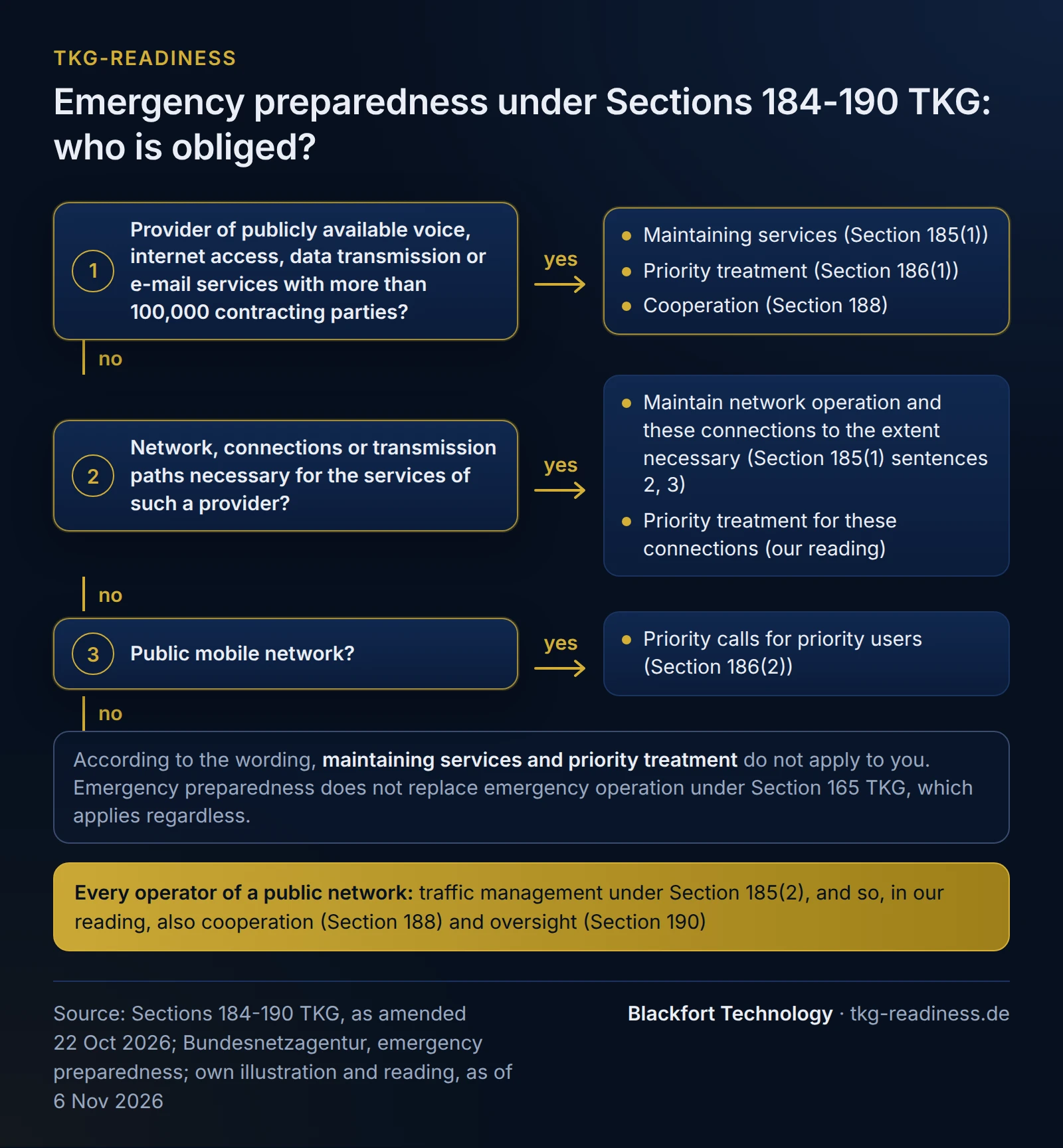
Under Section 185(1) sentence 1, providers of publicly available telecommunications services with more than 100,000 contracting parties, for four services: voice communication, internet access, data transmission and e-mail. Operators of public telecommunications networks must maintain the operation of their network at least to the extent necessary for these services (sentence 2). Anyone who provides connections or transmission paths necessary for these services must also maintain these services (sentence 3).
In our reading, this means: a provider with up to 100,000 contracting parties is not subject to the duty for its own services. A small network operator is nevertheless obliged where its network or its connections are necessary for the services of a provider with more than 100,000 contracting parties, for example with a wholesale product under open access. The BNetzA describes the group of network operators in the same way on its website.
There is a discrepancy in how to count: the BNetzA FAQ refers to “a number of 100,000 contracting parties per service”. The Act only says “with more than 100,000 contracting parties” and makes no reference to the individual service. We reproduce the statutory wording and mark counting per service as the BNetzA's reading. If you are close to the threshold, you should clarify the counting method with the BNetzA. The draft TKG Amendment Act 2026 (Bundestag printed paper 21/8277) would write counting per service into the Act explicitly and extend Section 184 to foreseeable disruptions. It has not been passed (as of 6 November 2026), see TKG Amendment Act 2026.
Regardless of the threshold, Section 185(2) requires every operator of a public telecommunications network to manage traffic where and for as long as this is necessary to prevent impending network congestion or to remedy congestion that has occurred. Equivalent types of traffic must be treated equally. Because Sections 188 and 190 refer to “those obliged under this chapter”, cooperation and oversight can, in our reading, apply to every network operator, even without a wholesale product. Subsection 3 requires those obliged under subsection 1 to take measures against bottlenecks at interconnections, handover points and systems that control the services. The BNetzA has published a guideline on traffic management, which we do not reproduce here.
What does priority treatment in telecommunications mean?
Priority users have connections and transmission paths provided and repaired without delay and with priority, on request also with an increased data transmission rate (Section 186(1)). Obliged are network operators and providers under Section 185(1) sentence 1 that provide connections or transmission paths for the services to be maintained. Operators of public mobile networks additionally set up connections for interpersonal communication with priority for priority users (Section 186(2)). For this purpose they may restrict connections without priority, except emergency calls to 110 and 112 (Section 187(3)).
Under Section 186(3), priority users include constitutional bodies, federal, state and municipal authorities, courts, the armed forces (Bundeswehr), disaster and civil protection, bodies responsible for health care, relief and rescue services, and broadcasters. They are joined by users with a certificate from an authority confirming tasks essential to life or defence. The certificate is valid for no more than ten years from issue, and the BNetzA provides a model certificate for it (version 2.0, May 2022).
The procedure is set out in the Act:
- Request: Priority users inform their provider in good time which connections are to be repaired with priority and for which mobile connections priority calls are to be used. Users with a certificate present it (Section 187(1)). According to the BNetzA, an informal request directly to the company is sufficient. After a change of provider, priority must be claimed again with the new provider.
- Implementation: The obliged party makes the arrangements without delay after receipt and informs the user when they are complete (Section 187(2)).
- Removal: After the connection is terminated or the certificate expires, it removes the arrangements, unless a new certificate is presented, and also informs the user.
- Fee: a one-off EUR 100 per connection or transmission path with priority repair and EUR 50 per mobile connection with priority calls (Section 189). This settles all fee claims for priority treatment. The other charges for the services remain.
If a provider cannot implement the measures itself, according to the BNetzA FAQ it forwards them without delay to the obliged partner company. In our assessment, this is the most likely route by which a priority request reaches a small network operator with a wholesale product.
What further duties and powers are there?
Cooperation in working groups (Section 188): When ordered by the Federal Ministry for Digital Transformation and Government Modernisation, those obliged take part in working groups in Germany during crises and in preparedness planning and exercises, and provide the necessary specialist staff. They receive compensation per person and per hour or part of an hour under the Judicial Remuneration and Compensation Act (JVEG), for no more than eight hours a day.
Oversight (Section 190): The BNetzA can issue orders, request information and enter and inspect business and operating premises during normal hours. The obliged party has to tolerate the inspection. To enforce this, the BNetzA can impose a periodic penalty payment of up to one million euros.
Fines (Section 228 TKG): The offences are listed in subsection 2 nos. 61 to 67. For the range up to EUR 100,000, subsection 6 no. 4 lists the numbers “61, 63 to 66”, that is the information duty under Section 190 and the priority duties under Sections 186 and 187. No. 62, failing to maintain services under Section 185(1), and no. 67, refusing to tolerate the inspection, appear in none of nos. 1 to 5 of subsection 6 and therefore, by our inference, fall under the remaining cases up to EUR 10,000. Whether no. 62 was left out deliberately cannot be determined from the wording. The classification of all offences is on the page fines under Section 228 TKG.
Is there an ordinance on emergency preparedness?
No. Sections 184 to 190 TKG contain no power to issue an ordinance, and no telecommunications ordinance on ensuring services is available on gesetze-im-internet.de. The former Post and Telecommunications Security Act (PTSG) has been repealed since 1 December 2021. According to the BNetzA, certificates issued under the PTSG remain valid. For priority calls in mobile networks, the BNetzA has made technical determinations in its Official Gazette under Section 186(2) (for GSM in 2012, UMTS and LTE in 2013, 5G in 2019), which we do not describe here.
The BNetzA pages on emergency preparedness are out of date on some points (as of 6 November 2026). For the order under Section 188, they name the “Federal Ministry for Digital and Transport”, whereas the Act now names the Federal Ministry for Digital Transformation and Government Modernisation. And the FAQ explains the relationship to critical infrastructure with Section 8d BSIG and the BSI-KritisV, that is with the old version of the BSI Act. For the duties themselves, the statutory wording applies. The responsible unit at the BNetzA is unit 218 in Mainz, reachable at notfallvorsorge@bnetza.de.
Example: emergency preparedness checklist for a regional network operator
Fictitious example, not a client. A regional fibre network operator with 25 employees supplies 31,000 contracting parties of its own with internet access and telephony. Through a wholesale product, it provides around 4,000 connections in its network to a nationwide provider with several million contracting parties. Its own customers include the district administration and a hospital. It does not operate a mobile network. The checklist records which emergency preparedness duties apply to it in our reading. All details are invented:
| Question | Provision | Facts in the example | Result (our reading) | Responsible, evidence |
|---|---|---|---|---|
| More than 100,000 contracting parties for voice, internet access, data transmission or e-mail? | Section 185(1) sentence 1 | 31,000 contracting parties | Duty to maintain its own services: no | Management, evidence: customer numbers per service recorded annually |
| Is the network necessary for the services of a provider with more than 100,000 contracting parties? | Section 185(1) sentences 2, 3 | Wholesale product for 4,000 connections of a nationwide provider | yes, maintain network operation and these connections to the extent necessary | Head of technology, evidence: wholesale contract, list of the network parts concerned |
| Priority treatment for connections provided for services to be maintained? | Section 186(1), Section 187 | Requests would come via the nationwide provider | yes, for these connections (procedure see below) | Head of customer service, evidence: procedure description, list of priority connections |
| Priority treatment for own customers such as the district administration and the hospital? | Section 186(1) | own connections, own services below the threshold | no duty according to the wording. Clarification with unit 218 recommended, priority repair can be agreed by contract | Management, evidence: request and reply |
| Priority calls in mobile networks? | Section 186(2) | no mobile network | no | - |
| Traffic management in case of network congestion? | Section 185(2) | public network | yes, regardless of customer numbers | Network operations, evidence: rules for congestion, equal treatment of equivalent types of traffic |
| Cooperation in working groups? | Section 188 | obliged through the wholesale product and through Section 185(2) | only when ordered, name a contact and a deputy | Security officer, evidence: contact list |
| Information requests and inspection by the BNetzA? | Section 190 | obliged through the wholesale product and through Section 185(2) | keep the documents from this checklist ready | Security officer, evidence: emergency preparedness file |
For the priority connections from the wholesale product, the network operator sets out a short procedure:
| Step | What happens | Basis | Who |
|---|---|---|---|
| 1 Receipt | Notification from the nationwide provider with connection ID, number under Section 186(3) or certificate with date of issue | Section 187(1), BNetzA FAQ on forwarding | Customer service |
| 2 Arrangement | Mark the connection as a priority connection in the fault management system, schedule repair with priority | Section 186(1), Section 187(2) sentence 1 | Network operations |
| 3 Information | Confirm completion of the arrangement | Section 187(2) sentence 3 | Customer service |
| 4 Follow-up | Monitor expiry of the certificate (no more than ten years) and termination | Section 186(3) sentence 2, Section 187(2) sentence 2 | Customer service |
| 5 Removal | Remove the marking, report the removal | Section 187(2) sentences 2, 3 | Network operations, customer service |
The Act does not say how the fees under Section 189 are split between the nationwide provider and the network operator. In our assessment, this belongs in the wholesale contract.
Three typical gaps
| Gap | Cause | Effect | Remedy |
|---|---|---|---|
| Threshold measured only against your own customers | Wholesale products and open access are forgotten when checking the 100,000 threshold | The duties under Section 185(1) sentences 2, 3 and Section 186(1) are not recognised for your own network | Checklist as in the example, repeated with every new wholesale contract |
| No procedure for priority treatment | Requests are rare and end up with general customer service | Arrangement not made without delay, the user is not informed, removal after ten years is forgotten | Fixed procedure with marking in the fault management system and follow-up |
| Emergency preparedness equated with emergency operation | Both topics have similar names and concern outages | Either emergency operation under Section 165 is missing, or duties under Sections 185 and 186 are overlooked | Document separately: emergency operation in the security concept under Section 166 TKG, emergency preparedness in the checklist |
If you want to know where your company stands on its TKG duties overall, start with the status review (stage 1). We have acted as security officers under Section 166 TKG and have drawn up and updated security concepts and agreed them with the Bundesnetzagentur.
Frequently asked questions
Does emergency preparedness apply to an ISP with 20,000 customers?+
Who issues the certificate for priority treatment?+
Does the PTSG still exist?+
What does priority treatment cost the user?+
Does emergency preparedness replace the emergency plan in the security concept?+
Read more
Sources
- TKG, Part 10 chapter 2: emergency preparedness, Sections 184-190 (gesetze-im-internet.de, German) (retrieved 2026-11-06)
- Section 185 TKG: duty to ensure telecommunications services (gesetze-im-internet.de, German) (retrieved 2026-11-06)
- Section 186 TKG: priority treatment in telecommunications (gesetze-im-internet.de, German) (retrieved 2026-11-06)
- Section 228 TKG: provisions on fines (gesetze-im-internet.de, German) (retrieved 2026-11-06)
- Bundesnetzagentur: emergency preparedness (German) (retrieved 2026-11-06)
- Bundesnetzagentur: FAQ on emergency preparedness (German) (retrieved 2026-11-06)
This content provides general technical and organisational information and does not constitute legal advice (no legal services within the meaning of the German RDG).