
Last updated: 2026-11-06
Legal status: German Telecommunications Act (Telekommunikationsgesetz, TKG) as amended on 22 October 2026, catalogue of security requirements version 2.0 of 29 April 2020, checked on 6 November 2026. This page looks in depth at one of the ten minimum measures. The overview of all of them is on the page protective measures under Section 165 TKG. This is general information, not legal advice. Whether and how a duty applies to your company is a question for a lawyer admitted in Germany. Quotations from German statutes and from the catalogue of security requirements on this page are our own unofficial translations. Only the German text is legally binding.
What does Section 165(2a) no. 3 TKG require?
The provision names three elements: “maintaining operations, such as backup management and recovery after an emergency, and crisis management”. It applies to operators of public telecommunications networks and providers of publicly available telecommunications services that are essential or important entities under Section 28 of the BSI Act (BSIG), which in our reading means practically every telecom provider (classification on the page NIS2 for telecom providers). Subsection 2a also requires an all-hazards approach that protects the physical environment of the systems as well. Power failure, fire, flooding and cable damage are therefore covered just as much as a cyber attack.
Two other subsections of Section 165 have supported this for some time. Under subsection 2, network operators and service providers must protect their systems against disruptions that lead to considerable impairment, including disruptions caused by attacks and disasters. Under subsection 5, every network operator must ensure the proper operation of its network and so the continuous availability of the services. Separately, Sections 184 to 190 TKG govern emergency preparedness in telecommunications for large-scale emergencies. Its duty to ensure services under Section 185(1) applies to service providers with more than 100,000 contracting parties and to the network operators whose network is needed for these services.
What does catalogue 2.0 in force require?
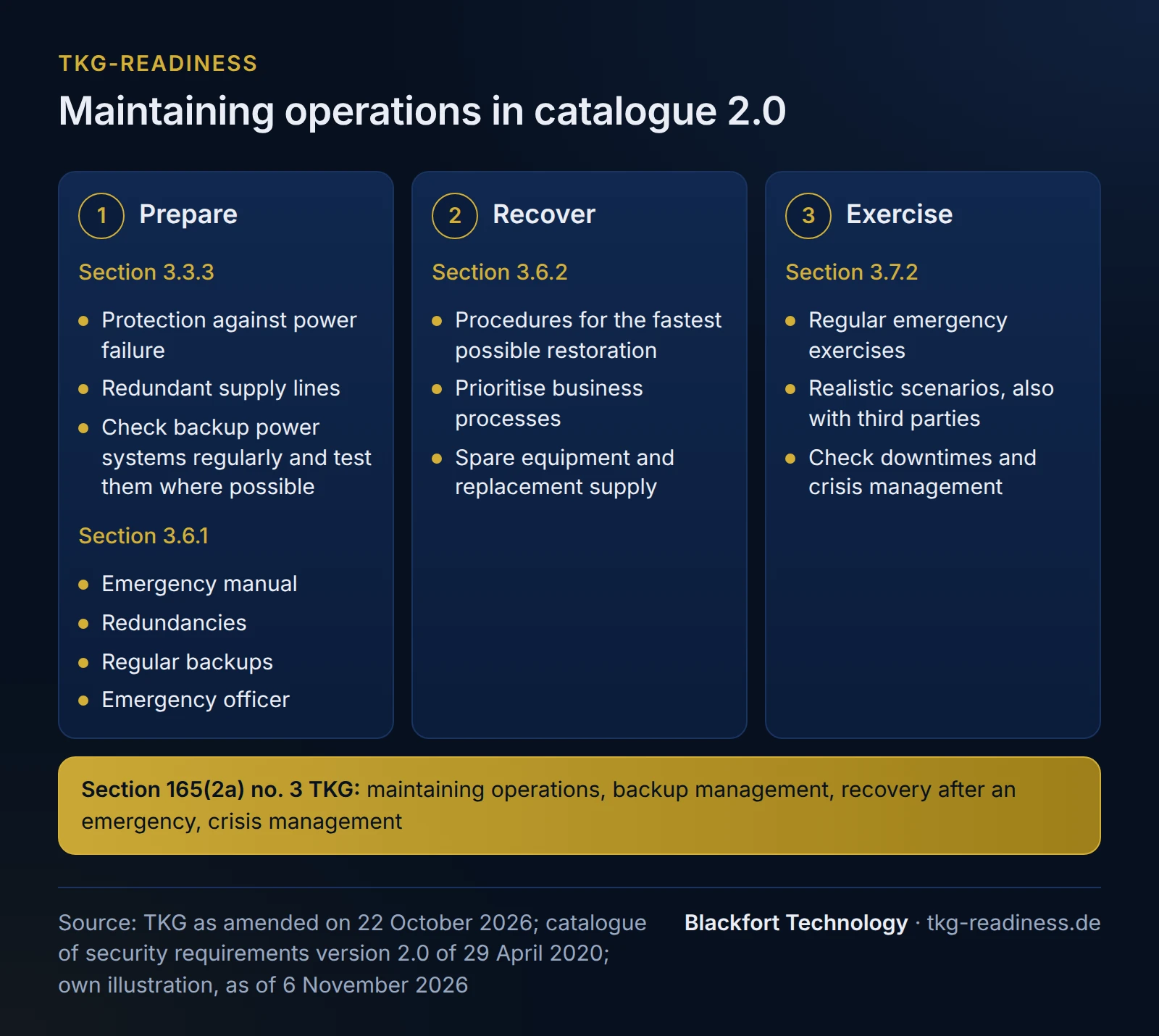
Chapter 3 of catalogue 2.0 is mandatory for all obliged companies. Four sections are relevant to maintaining operations:
| Section | Requirements (in short) |
|---|---|
| 3.3.3 Security of supply | protect equipment and resources against power failures and other disruptions; redundant lines over different supply routes; dimension and monitor air conditioning and power supply adequately; check switchgear, backup generators and batteries regularly and test them where possible; protect the delivery and provision of supplies |
| 3.6.1 Business continuity management | emergency manual with current contacts, ensure access to it; appropriate redundancies, tested or switched over regularly; regular backups of critical systems and data, observing deletion and retention periods; emergency plans for critical systems, evaluated regularly; appoint an emergency officer |
| 3.6.2 Disaster recovery management | procedures for restoring important services as fast as possible; prioritise business processes for recovery; check supplier contracts for replacement supply; spare equipment and, in individual cases, mobile backup power units as possible measures |
| 3.7.2 Emergency exercises | exercise regularly, with third parties where possible, using realistic and varied scenarios; record whether planned downtimes are met and whether crisis management fulfils its tasks |
Catalogue 2.0 also grades networks and services by criticality. Above 100,000 subscribers it presumes elevated criticality. Measures against considerable disruption from natural disasters, serious accidents, sabotage and terrorist attacks are then added, expressly including emergency preparedness measures. Most regional providers are below this level.
What would draft version 2025-10 change?
The draft of the new catalogue (version 2025-10) has not been adopted (as of 6 November 2026), and catalogue 2.0 continues to apply. The draft would grade the requirements by a new threat potential in three levels, with measures in categories a), b) and c). This classification does not apply today (details on the page catalogue of security requirements under Section 167 TKG). For maintaining operations, these points would be new above all:
| Section in the draft | Category a) | Category b) | Category c) |
|---|---|---|---|
| 4.4.2 Security of supply | secure deliveries relevant to security of supply | define to what extent operations must be maintained if the public power grid fails; protect the supply, for example with backup batteries, diesel generators, reserve fuel; take into account the guideline “Notstromversorgung in Unternehmen und Behörden” (backup power supply in companies and public authorities) of the Federal Office of Civil Protection and Disaster Assistance (BBK) | active cooling, backup generators, service level agreements with fuel suppliers, redundant cooling and power supply |
| 4.8.1 Strategy and emergency plans | strategy for maintaining networks and services | emergency plans for all systems relevant to operations, record recovery times | revise plans after incidents, overview of dependencies relevant to operations |
| 4.8.2 Recovery | document recovery planning, immediately available in an emergency; document recovery times of the central services and networks | emergency manual, regular tests of recovery times | adequately dimensioned disaster recovery capacity |
| 4.8.3 Backup strategy | backups “should” be stored physically and logically separated; check regularly that backups work | backups “must” be stored separately; document backup procedures; geo-redundant backup solutions | no further measures |
The Bundesnetzagentur (BNetzA), the German Federal Network Agency, itself states in the explanatory notes that for companies with normal threat potential the draft still stays below the 3-2-1 rule for backups (three copies, two storage media, one copy off site). For setting up emergency management, the draft refers to BSI Standard 100-4 of the Federal Office for Information Security (BSI).
Backup power and network outages: what matters in a telecom network
Catalogue 2.0 requires protection against power failure, but no particular technology and no minimum runtime. How long a network node has to run without mains power is something you set from your risk analysis. From category b), the draft would expressly require this extent to be defined. In our professional view, planning should cover:
- Runtimes per site: How long do batteries bridge network nodes, distribution points and the core network? Is there a generator or a connection point for a mobile backup power unit?
- External dependencies: Customers' terminal equipment runs on household power. In a wide-area power cut, the customer side is disconnected even if the network node keeps running. This belongs in communication with customers and authorities.
- Cooling: If the equipment runs on backup power but the air conditioning does not, temperature limits the runtime.
- Fuel and access: Who refuels a generator after how long, and who can get into the site during a power cut if the locking system is electric?
- Testing under load: Catalogue 2.0 requires backup power systems to be checked regularly and tested where possible. A test without load says little about the actual runtime.
In a telecom network, backup is about more than servers. Configurations of routers, OLTs and session border controllers, the provisioning of customer lines and the customer database all have to be restorable after an outage or an attack. Whether an outage has to be reported as a significant security incident is explained on the page incident reporting under Section 168 TKG. If remote maintenance is the only way to reach the network elements in an emergency, it belongs in the plan too, see access to network elements.
Example: recovery plan for the telecoms arm of a municipal utility
Fictitious example, not a client. Alongside electricity and water, a municipal utility (Stadtwerk) runs a fibre network with around 6,000 connections. The equipment sits in two network nodes, the core network and the customer systems in the utility's data centre. The telecoms arm offers internet access and telephony itself. Scenario: power cut in the supply area, network node 1 is running on battery. The recovery plan could look like this, all figures invented:
| Priority | Service or system | Dependency | Recovery time (target) | Measure in an emergency | Responsible | Last test |
|---|---|---|---|---|---|---|
| 1 | Core network, routing, connection to the upstream provider | data centre power, transit | keeps running, outage under 15 minutes | generator in the data centre, second transit route | head of network operations | load test 04/2026 |
| 2 | Network nodes 1 and 2 (OLT, aggregation) | battery, no generator | battery 4 hours, then mobile backup power unit | request the backup power unit after 2 hours, connection point in place | on-call duty | battery test 02/2026, backup power unit never connected |
| 3 | Telephony (session border controller, emergency call routing) | core network, upstream telephony provider | under 1 hour | switch over to second instance | head of IT | switchover 06/2026 |
| 4 | Configurations of the network elements | backup server, off-site copy | restore under 2 hours per device | restore from the last daily backup | head of IT | restore 05/2026 |
| 5 | Customer management, provisioning, fault reporting | data centre, customer service phone system | 8 hours | fault announcement, emergency operation with a paper list | customer service | not tested |
The plan also sets out the emergency officer and their deputy, the crisis management team with contact details, a printed copy of the emergency manual in both network nodes, and communication with customers and the Bundesnetzagentur. Rows 2 and 5 show the open points, and the next exercise should start there. The other divisions follow their own rules: the power grid falls under Section 5c of the Energy Industry Act (EnWG) with the IT security catalogue, the drinking water supply in our reading under the BSI Act, see municipal utilities with a telecoms arm.
Three typical gaps
| Gap | Cause | Effect | Remedy |
|---|---|---|---|
| Backup without a restore test | backups run automatically, nobody has practised restoring them | in a real emergency, keys, software or time are missing and the backup does not help | test restoring each class of system at least once a year and record how long it takes |
| Backup power never tested under load | batteries and generator have been in place since construction, maintenance without a load test | the runtime in the plan is an assumption, while catalogue 2.0 requires checks and, where possible, tests | schedule a load test and check cooling and access to the site at the same time |
| Emergency manual only on the network | the manual sits on the file server or in the wiki | during a power cut or an attack it is unavailable exactly when needed, while catalogue 2.0 requires access to it to be ensured | current version printed at the sites and offline with the emergency officer |
If you want to know where your company stands on the ten minimum measures as a whole, start with the status review (stage 1). We have acted as security officers under Section 166 TKG and have drawn up and updated security concepts and agreed them with the Bundesnetzagentur.
Frequently asked questions
Do I need a backup generator for every network node?+
How often do backups and backup power have to be tested?+
Is the 3-2-1 rule for backups enough?+
Does a network outage have to be reported?+
Who is responsible in an emergency?+
Read more
Sources
- Section 165 TKG: technical and organisational safeguards (gesetze-im-internet.de, German) (retrieved 2026-11-06)
- Section 185 TKG: duty to ensure telecommunications services (gesetze-im-internet.de, German) (retrieved 2026-11-06)
- Section 5c Energy Industry Act (EnWG): IT security in plant and network operation (gesetze-im-internet.de, German) (retrieved 2026-11-06)
- Bundesnetzagentur: catalogue of security requirements version 2.0 of 29 April 2020 (PDF, German) (retrieved 2026-11-06)
- Bundesnetzagentur: consultation on the revised catalogue of security requirements (German) (retrieved 2026-11-06)
- Bundesnetzagentur: draft catalogue of security requirements, version 2025-10 (PDF, German) (retrieved 2026-11-06)
- Bundesnetzagentur: emergency preparedness in telecommunications (German) (retrieved 2026-11-06)
This content provides general technical and organisational information and does not constitute legal advice (no legal services within the meaning of the German RDG).