

Last updated: 2026-11-06
Legal status: German Telecommunications Act (Telekommunikationsgesetz, TKG) as amended on 22 October 2026, checked on 6 November 2026. Section 168 has applied in its NIS2 version since 6 December 2025, without a transition period. This page provides general information, not legal advice. Whether a specific incident must be reported is assessed by the provider. Legal questions about your case are a matter for a lawyer admitted in Germany.
When is a security incident significant?
Under Section 168(3) TKG an incident is significant if it has caused or can cause severe operational disruption or financial loss for the provider, or if it has affected or can affect other natural or legal persons by causing considerable material or non-material damage. The possibility of such damage is enough.
A security incident is any event that compromises the availability, authenticity, integrity or confidentiality of data or services (Section 3 no. 53 TKG). The TKG includes authenticity, which the definition in the German BSI Act leaves out. Because the definition covers any event, in our reading an outage without an attacker can also qualify.
The Bundesnetzagentur gives indicators in its reporting concept for when it considers an incident significant. These are thresholds set by the authority, not by the statute:
- more than 1 million affected user hours (affected users multiplied by duration in hours),
- any incident at international interconnection points,
- any incident affecting emergency call routing, meaning the dedicated hardware and software used for it, not a single customer line.
The BNetzA stresses that the list is not exhaustive, that each provider assesses incidents on its own responsibility and that voluntary reports are welcome. For a small provider this means, in our assessment, that the user-hours threshold is rarely reached, so the assessment against the two statutory criteria still has to be made.
Who reports, and to whom?
Every operator of a public telecommunications network and every provider of publicly available telecommunications services, regardless of size and of the classification under the BSI Act. According to the BNetzA, providers of number-independent services such as messaging have also been covered since the TKG 2021. Reports always go to both authorities: the Bundesnetzagentur and the BSI.
The reporting duty under Section 32 of the BSI Act does not apply to telecom providers (Section 28(5) BSIG). They report under Section 168 TKG instead, unless further activities fall under the BSI Act, as explained on NIS2 for telecom providers in Germany. Providers based abroad that serve customers in Germany report through the same channels. What else applies to them is set out on the page for telecom providers based outside Germany.
Which report is due when?
Section 168(1) and (2) provide for up to five reports. Deadlines run from the moment the provider becomes aware of the significant incident:
| Report | Deadline | Content under the statute | Name on the BNetzA form |
|---|---|---|---|
| Early warning (subsection 1 no. 1) | without undue delay, within 24 hours of becoming aware | whether the incident is suspected of being caused by unlawful or malicious acts or could have a cross-border impact | Initialmeldung |
| Incident notification (subsection 1 no. 2) | without undue delay, within 72 hours of becoming aware | update or confirmation of the early warning, first assessment including severity and impact, indicators of compromise where available | Folgemeldung |
| Intermediate report (subsection 1 no. 3) | only at the request of the BNetzA or the BSI | relevant status updates | - |
| Final report (subsection 1 no. 4) | no later than one month after the 72-hour notification | detailed description including severity and impact, type of threat or root cause, mitigation measures applied and ongoing, cross-border impact where applicable | Abschlussmeldung |
| Progress report (subsection 2) | instead of the final report if the incident is still ongoing after one month; the final report then follows one month after handling has ended | the statute sets no content (sensible: state of handling) | - |
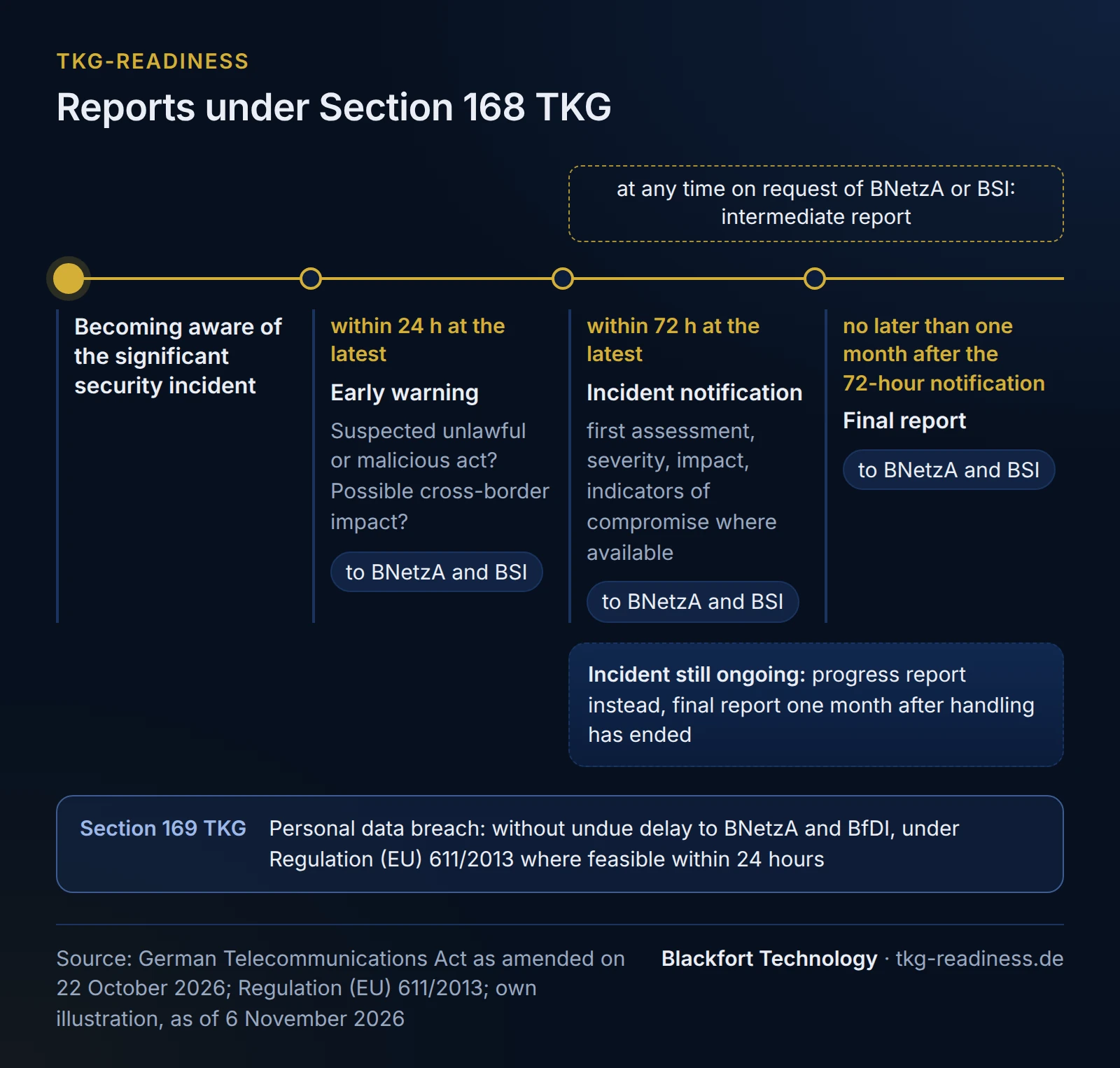
Where possible, the BNetzA acknowledges receipt within 24 hours of the early warning. On request, the BSI can provide technical support and advice on mitigation, and the BNetzA can ask for a detailed report. The provisions of the Federal Data Protection Act protecting against self-incrimination apply accordingly (Section 168(1) sentence 2 TKG). Separately, where there is a particular and significant threat, providers must inform potentially affected users of possible protective measures and, where appropriate, of the threat itself (Section 168(7)).
How to report in practice: the BNetzA reporting concept and form
The BNetzA sets the details of the procedure (Section 168(4)) and has published a reporting concept and a reporting form (in German). Its website describes both as drafts. Reports are sent with the form by e-mail to the BNetzA (sicherheitsvorfall.tkg@bnetza.de) and to the BSI (Meldungen-tkg@bsi.bund.de) or by fax, and by post only where there is no urgency. The BNetzA recommends encrypting the e-mail with PGP.
Three points from the reporting concept matter for your organisation. If in doubt, containing the immediate effects comes before the report. A provider that uses third parties to detect incidents, such as an on-call contractor, remains responsible. And organisational shortcomings that delay a report count against the provider.
Where the BNetzA documents differ from the statute
The reporting concept and form predate the current Section 168 or were only partly updated. The statutory text prevails. In detail:
| Point | Statute (Section 168 TKG) | BNetzA document | Our recommendation |
|---|---|---|---|
| Version of the form | wording in force since 6 December 2025 | form dated 12/2021, before the NIS2 transposition; reporting concept cover page dated 28 February 2022, content partly updated to NIS2 | use the form and add in the description what, by our review, it does not ask explicitly: suspected unlawful or malicious act, cross-border impact, indicators of compromise |
| 3-hour early alert | none; early warning within 24 hours for all | alert within 3 hours for providers with increased threat potential, today only 5G network operators | for everyone else neither statute nor concept sets 3 hours, but do not wait until hour 24 |
| Significance criteria | two criteria in subsection 3 | treats number of users, duration, geographic spread and further criteria as “expressly laid down” | assess under subsection 3 and use the BNetzA criteria as indicators |
| Reference point of the final report | one month after the 72-hour notification | website: one month after the early warning | plan cautiously from the early warning, which also meets the statutory date |
| Ongoing incident | progress report (subsection 2); intermediate report only on request | website: intermediate report | label the report as a progress report under Section 168(2) |
| Provision on fines | Section 228(2) no. 39 TKG | reporting concept: Section 228(1) no. 39 | no effect on the report, a citation error only |
How Section 168 differs from Section 169 TKG
Section 169 sets a separate route for personal data breaches: providers of publicly available services notify the BNetzA and the Federal Commissioner for Data Protection and Freedom of Information (BfDI), not the BSI, without undue delay and, under Regulation (EU) 611/2013, where feasible within 24 hours of detection. An attack on customer data can trigger both duties, and the reports under Sections 168 and 169 then run in parallel. Deadlines, notifying the persons affected, the breach inventory and how this differs from Article 33 GDPR are covered on the page notifying personal data breaches under Section 169 TKG.
Internal reporting procedure: who does what?
The deadlines are short and often fall on evenings and weekends. A reporting procedure works only if it is settled in advance who assesses, who approves and who sends. The following split of roles is our recommendation for small and mid-sized providers. The statute does not prescribe it.
| Role | Task in the procedure | Deputy |
|---|---|---|
| Network operations on call (in-house or contractor) | detects the disruption, secures first data, calls along the escalation list | second on-call |
| Security officer under Section 166 TKG | assesses significance, keeps track of deadlines, completes the form | designated deputy |
| Management | approves reports, decides on customer information | second managing director or authorised officer |
| Data protection officer | checks whether personal data is affected and Section 169 applies | data protection coordinator |
| Customer service | outage notice to customers, handles enquiries | head of sales |
Exercise script: voice platform outage on a Friday evening
Example, not a client. A VoIP provider with 30 employees runs a voice platform for business customers with around 9,000 numbers. It provides a publicly available telecommunications service and therefore reports under Section 168. The script works for a two-hour tabletop exercise. We count the deadlines cautiously from the first concrete suspicion. When awareness exists in the legal sense has to be assessed case by case.
| Time | Event | Role | Decision or result |
|---|---|---|---|
| Fri 16:40 | monitoring shows mass registration failures, some customers cannot make calls | on call | ticket opened, first log data secured |
| Fri 16:55 | an unknown administrator account is found on the session border controller, the routing configuration has been changed | on call | suspected attack, call to the security officer; internal clock starts: 16:55 |
| Fri 17:15 | first assessment: about 3,000 numbers without service, including medical practices and a care service, end not in sight | security officer | assessed as significant (severe disruption, possible damage to customers, Section 168(3)), assessment recorded in writing; management informed |
| Fri 17:30 | account locked, backed-up configuration restored | on call | containment before reporting, service back from 18:10 |
| Fri 19:00 | early warning on the form (Initialmeldung): malicious act suspected yes, cross-border impact not known | security officer, approval by management | e-mail to BNetzA and BSI; with awareness from 16:55 the deadline would be Sat 16:55 |
| Sat 10:00 | analysis: the attacker had access to a table of customer data, exfiltration cannot be ruled out | data protection officer | personal data breach, notification under Section 169 to BNetzA and BfDI prepared |
| Sat 14:00 | notification under Section 169 sent, entry in the breach inventory | data protection officer, approval by management | decision on notifying the persons affected documented |
| Mon 12:00 | incident notification with first assessment (Folgemeldung): severity, duration, affected numbers, indicators of compromise (source IP addresses, account name) | security officer, approval by management | with awareness from 16:55 the deadline would be Mon 16:55 |
| Mon 12:00 + 1 month | final report with root cause (unpatched management interface), mitigation (patch, access only via VPN with multi-factor authentication), no cross-border impact | security officer, approval by management | if handling is still ongoing: progress report, final report one month after completion |
| afterwards | lessons learned, measures added to the incident process | security officer | check whether the security concept needs updating |
Questions for the exercise: who approves at 19:00 on Friday if management cannot be reached? Are the form, recipient addresses and PGP keys at hand? Who decides whether customers are told about the threat? Where do the user numbers for the assessment come from?
Roles, deadlines, a deadline calculator, an incident log and this script are available as an Excel template (in German) for the internal reporting procedure on the page templates for telecom providers.
Three common gaps
| Gap | Cause | Effect | Remedy |
|---|---|---|---|
| Report goes only to the BNetzA | procedure dates from before 6 December 2025 or lists only one address | the report under Section 168(1) is incomplete, the BSI is not informed | store both recipients in the sending step of the form |
| On-call staff do not know the reporting duty | network operations are outsourced and the contract only covers fault repair | the 24-hour period runs without the security officer knowing, and this counts against the provider | add the duty to escalate and contact details to the contract and the escalation list |
| Section 169 is overlooked | the incident is handled as an outage only, the data protection officer is not involved | BNetzA and BfDI are not notified without undue delay, the inventory entry is missing | make “personal data affected?” a fixed step in the procedure |
How incident handling fits with the other safeguards is explained under protective measures under Section 165 TKG. If you want your reporting procedure reviewed or an exercise prepared, get in touch. A structured starting point is the status review (stage 1). We have acted as security officers under Section 166 TKG and have drawn up and updated security concepts and agreed them with the Bundesnetzagentur.
Frequently asked questions
Do I have to report if I am not yet sure the incident is significant?+
Is there a 3-hour deadline for telecom providers?+
Is a report to the Bundesnetzagentur enough?+
What fine applies to a late report?+
What is the difference between an intermediate report and a progress report?+
Read more
- Section 165 TKG: Protective Measures, Ten Minimum Measures
- NIS2 for Telecom Providers in Germany: TKG Duties, Registration
- Section 166 TKG Security Concept: German Telecommunications Act
- Security Officer under Section 166 TKG: Tasks and Appointment
- Section 169 TKG: Notifying Data Breaches to BNetzA and BfDI
- German Telecommunications Act (TKG): Telecom Security Services
Sources
- Section 168 TKG: reporting security incidents (gesetze-im-internet.de, German) (retrieved 2026-11-06)
- Section 169 TKG: data and information security (gesetze-im-internet.de, German) (retrieved 2026-11-06)
- Regulation (EU) No 611/2013 on measures applicable to the notification of personal data breaches (Official Journal L 173/2) (retrieved 2026-11-06)
- Section 3 TKG: definitions (gesetze-im-internet.de, German) (retrieved 2026-11-06)
- Section 228 TKG: fines (gesetze-im-internet.de, German) (retrieved 2026-11-06)
- Section 28 BSI Act: exception for telecom providers in subsection 5 (gesetze-im-internet.de, German) (retrieved 2026-11-06)
- Section 32 BSI Act: reporting duties (gesetze-im-internet.de, German) (retrieved 2026-11-06)
- Section 17 Administrative Offences Act: amount of the fine (gesetze-im-internet.de, German) (retrieved 2026-11-06)
- Bundesnetzagentur: reporting a security incident (German) (retrieved 2026-11-06)
- Bundesnetzagentur: reporting concept for significant security incidents under Section 168 TKG (PDF, German) (retrieved 2026-11-06)
- Bundesnetzagentur: reporting form under Section 168 TKG, version 12/2021 (PDF, German) (retrieved 2026-11-06)
This content provides general technical and organisational information and does not constitute legal advice (no legal services within the meaning of the German RDG).