
Last updated: 2026-11-06
Legal status: German Telecommunications Act (Telekommunikationsgesetz, TKG) and BSI Act (BSI-Gesetz, BSIG), each as amended on 22 October 2026, checked on 6 November 2026. This page covers what Section 165 TKG and the catalogue under Section 167 require. How to describe the measures in your security concept and submit it to the Bundesnetzagentur (BNetzA), the German Federal Network Agency, is explained on the page security concept under Section 166 TKG. This is general information, not legal advice. Whether and how a duty applies to your company is a question for a lawyer admitted in Germany.
Who has to meet which subsection of Section 165?
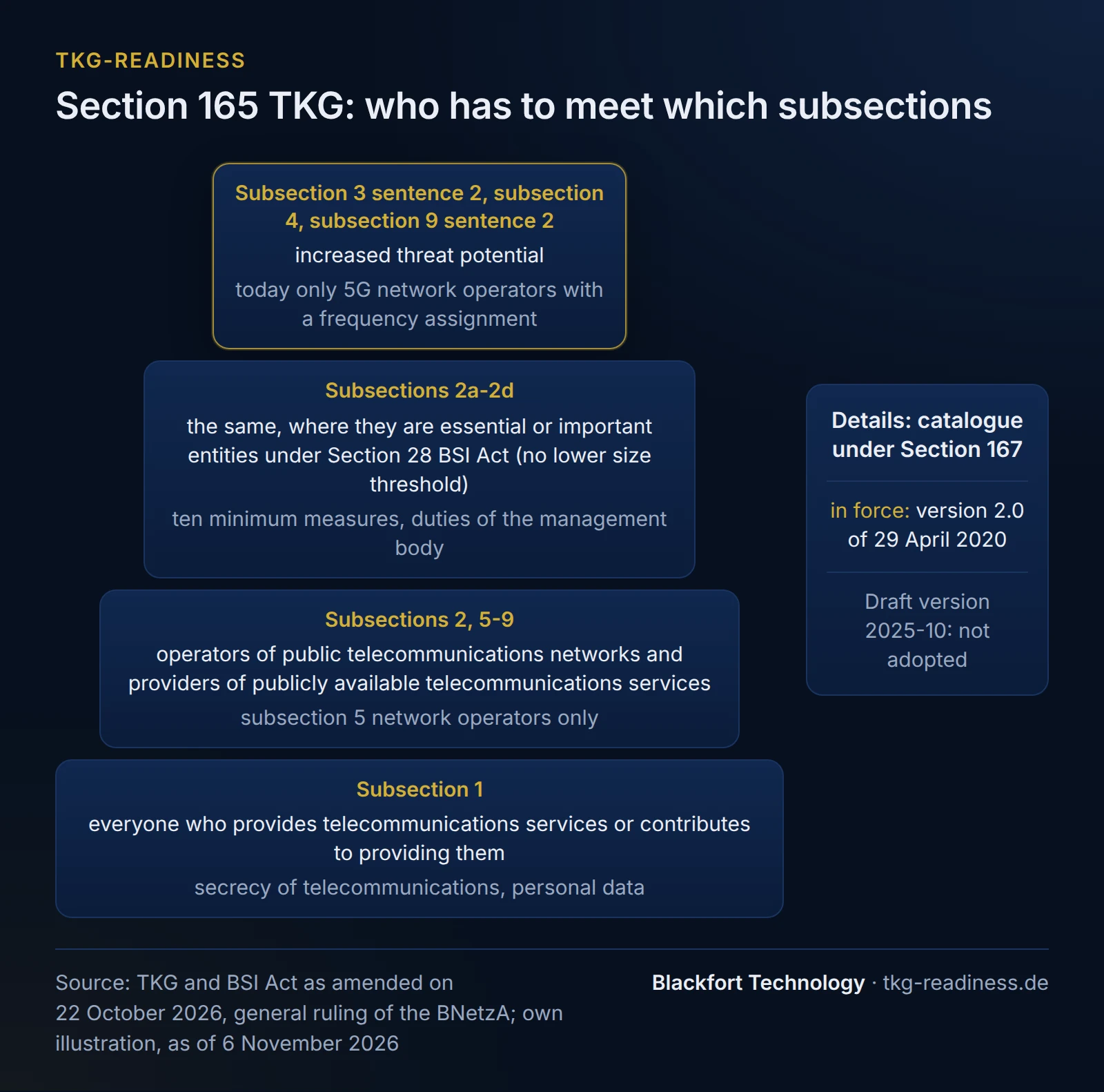
Section 165 addresses different groups in different subsections, from anyone who contributes to a telecommunications service up to 5G network operators. The table summarises the statutory text in short form.
| Subsection | Content | Who is obliged |
|---|---|---|
| 1 | Protection of the secrecy of telecommunications and of personal data, state of the art | anyone who provides telecommunications services or contributes to providing them, including non-public services |
| 2 | Protection against disruptions, managing security risks, a level of security appropriate to the risk | operators of public telecommunications networks and providers of publicly available telecommunications services |
| 2a | All-hazards approach, ten minimum measures | the same, where they are essential or important entities under Section 28 BSIG |
| 2b to 2d | Implementation and oversight by management, liability, training | the management body of these entities |
| 3 | Attack detection systems | sentence 1: all network operators and service providers may use them; sentence 2: mandatory with increased threat potential |
| 4 | Certification of critical components before first use | network operators with increased threat potential only |
| 5 | Proper network operation, continuous availability of services | operators of public telecommunications networks |
| 6 | Test of appropriateness | applies to all measures |
| 7 | Shared sites and facilities | every party involved, unless a duty can be assigned to one of them |
| 8 | Orders by the BNetzA after an incident or in case of significant danger | power of the authority |
| 9 | Audit by a qualified independent body | sentence 1: any network operator or service provider when ordered; sentence 2: network operators with increased threat potential every two years |
| 10, 11 | Informing the Federal Office for Information Security (BSI) about deficiencies, support for the BNetzA | powers and duties of the authorities |
Subsections 2a to 2d depend on the classification under Section 28 BSIG. Under Section 28(1) and (2) BSIG, operators of public telecommunications networks and providers of publicly available telecommunications services are at least important entities, with no lower size threshold. In our reading, the ten minimum measures therefore apply to practically everyone addressed by subsection 2. Classification and the duties of management under subsections 2b to 2d are covered on NIS2 for telecom providers in Germany.
What do subsections 1 and 2 require?
Subsection 1 requires appropriate precautions to protect the secrecy of telecommunications and to prevent breaches of personal data protection, taking the state of the art into account. It also covers companies that only contribute to providing a service, in our reading for example contractors in network operations.
Subsection 2 is the core rule for network operators and service providers. They must protect their telecommunications and data processing systems against disruptions that lead to significant impairments, including attacks from outside and disasters, and they must manage the risks to the security of networks and services. In particular, systems must be secured against unauthorised access, and the impact of security breaches must be kept as small as possible, where appropriate through encryption.
The yardstick is a level of security appropriate to the existing risk. The statute lists the state of the art, relevant European and international standards, the cost of implementation, risk exposure, the size of the provider and the likelihood, severity and impact of incidents. Subsection 6 adds that measures are appropriate if the effort is not out of proportion to the importance of the networks or services. A fibre provider with a few thousand lines therefore does not have to do what a nationwide mobile network operator does. It does have to be able to explain why its measures match its risk.
The ten minimum measures under Section 165(2a)
Subsection 2a requires the measures under subsection 2 to follow an all-hazards approach that protects network and information systems and their physical environment against incidents, and to include at least the ten points below. It has applied since 6 December 2025 without a transition period.
The table separates three things. The second column summarises the statutory duty. The third column is our professional recommendation: the statute names no type of evidence, so the documents listed are common examples, neither complete nor mandatory. The fourth column maps each measure to sections of the catalogue of security requirements in force. That mapping is ours as well, because catalogue 2.0 predates subsection 2a. For point 10 in particular, version 2.0 contains no general requirement for multi-factor authentication. It only recommends stronger authentication for end customers in annex 1, so the duty comes from the statute. A worked example follows further down.
| No. | Statutory duty (Section 165(2a)) | Recommendation: suitable evidence | Catalogue 2.0, chapter 3 (our mapping) |
|---|---|---|---|
| 1 | Policies on risk analysis and information system security | Risk analysis method, risk register with date and approval, security policy | 3.1.1 Organisational and risk management |
| 2 | Incident handling | Incident process with roles and contact details, incident records, reporting procedure under Section 168 | 3.5.1 to 3.5.3 Detection, handling, communication and reporting |
| 3 | Business continuity, backup management, disaster recovery, crisis management | Emergency manual, backup policy, recovery test records, crisis team arrangements, exercise report. In depth: business continuity in telecom networks | 3.6.1, 3.6.2 Continuity and recovery; 3.7.2 Emergency exercises |
| 4 | Supply chain security, including relationships with direct suppliers and service providers | List of suppliers and contractors with criticality, security clauses in contracts, documented assessments. In depth: supply chain in telecom networks | 3.1.3 Supplier management |
| 5 | Security in acquisition, development and maintenance, including vulnerability handling and disclosure | Patch and vulnerability process, scan reports, change records, a contact point for vulnerability reports | 3.4.2 Change management; 3.7.3 Testing of network and IT systems |
| 6 | Policies and procedures to assess the effectiveness of the measures | Metrics, internal audit plan, audit reports, report to management | 3.7.1 Monitoring and logging; 3.7.3 Testing |
| 7 | Basic procedures and training on the security of networks and services | Training plan, attendance lists, awareness content | 3.2.2 Security knowledge and awareness |
| 8 | Policies and procedures on cryptography and encryption | Cryptography policy (which links and data are encrypted, key management), certificate inventory | 3.3.6 Confidentiality of communication |
| 9 | Human resources security, access control, asset management | Joiner and leaver process, role and permission concept with regular review, asset inventory. In depth: access to network elements | 3.2.1, 3.2.3 Personnel; 3.3.4 Access control; 3.4.3 Asset management |
| 10 | Multi-factor or continuous authentication, secured voice, video and text communication, secured emergency communication where appropriate | List of accesses with MFA (administration, remote access), rule for internal communication tools, tested emergency communication channel. More on MFA: access to network elements | 3.3.4 Access control; 3.3.6 Confidentiality of communication (no MFA requirement in version 2.0) |
The measures belong in the security concept: Section 166(1) no. 3 TKG requires the concept to set out the measures taken to meet Section 165(1) to (7), which in our reading has included subsection 2a since 6 December 2025.
What do the other subsections cover?
Attack detection (subsection 3): network operators and service providers may use attack detection systems as defined in Section 2 no. 41 BSIG. They are mandatory only with increased threat potential, and must then detect threats through continuous, automatic recording and analysis.
Critical components (subsection 4): network operators with increased threat potential may only use critical components that a recognised certification body has tested and certified before first use. The basis is the BSI technical guideline TR-03163, the deadline for each component falls on 1 January 2026 at the earliest, and components already in use do not have to be recertified. The list of critical functions, the deadlines and Section 41 BSIG are explained on the page critical components in telecommunications.
Shared sites (subsection 7): where sites or technical facilities are shared, every party has the duties under subsections 1 to 5 unless they can be assigned to one party. For cooperations, open access models and colocation it pays to allocate responsibilities in writing.
Orders and audits (subsections 8 to 11): after an incident or in case of significant danger, the BNetzA can order measures and set deadlines. It can require any network operator or service provider to undergo an audit by a qualified independent body or a competent national authority. Network operators with increased threat potential must undergo this audit every two years at their own cost. The BNetzA assesses deficiencies in the security concept in agreement with the BSI.
Increased threat potential currently applies, under the BNetzA's general ruling in force, only to operators of public 5G mobile networks with a frequency assignment. Subsection 3 sentence 2, subsection 4 and subsection 9 sentence 2 do not currently apply to a fibre provider, the telecoms arm of a municipal utility or a VoIP provider.
The catalogue under Section 167 in brief
The BNetzA sets the details of the measures under Section 165(1) to (7) in the catalogue of security requirements under Section 167 TKG, in agreement with the BSI and the Federal Commissioner for Data Protection and Freedom of Information (BfDI). Version 2.0 of 29 April 2020 is in force, and draft version 2025-10 has not been adopted (as of 6 November 2026). Structure, requirements per chapter and the comparison with the draft are on the page catalogue of security requirements under Section 167 TKG.
The draft TKG Amendment Act 2026
The federal government's draft amendment act (Bundestag printed paper 21/8277) would change Section 165 in four places, among them tying the attack detection duty to essential entities and certification of critical components in the core network to network operators that are essential entities, and limiting the mandatory audit under subsection 9 to 5G network operators, every three years, by the BSI or a body it designates. First reading was on 9 October 2026, the committee hearing on 4 November 2026, and the act has not been adopted (as of 6 November 2026). This page describes the law in force. The state of the procedure and a comparison of the law in force with the draft are on the page TKG Amendment Act 2026.
Example: evidence table for a fibre provider
Example, not a client. A regional fibre provider with 12 employees and annual turnover below EUR 10 million runs an FTTH network in several municipalities and offers internet access and telephony. Night-time on-call duty for the network is outsourced to a contractor, and the data centre for the core network and customer systems is rented. The provider is an important entity under Section 28(2) BSIG, so subsection 2a applies. It does not have increased threat potential.
Its evidence table could look like this, one line per measure, all details invented:
| No. | Implementation at the example provider | Evidence (document, location) | Owner | Status |
|---|---|---|---|---|
| 1 | Annual risk analysis for network, customer systems and data centre, policy signed by management | Risk register, signed policy | Security officer | implemented |
| 2 | Incident process with thresholds for reporting under Section 168, on-call contractor included | Incident process, incident records, exercise script | Head of network operations | implemented, exercise planned |
| 3 | Daily configuration backup of network components, restore tested every six months, crisis team named | Backup policy, test records, emergency manual | Head of network operations | crisis team: exercise missing |
| 4 | List of all direct contractors with network access, security annex in contracts with on-call service and data centre | Contractor list, contract annexes | Management | partly: civil works contractor open |
| 5 | Monthly patch window, vulnerability scan of systems reachable from outside, contact address for reports | Patch records, scan reports | Head of IT | implemented |
| 6 | Four metrics (patch level, MFA coverage, backup tests, open risks), quarterly report to management | Quarterly report | Security officer | from next quarter |
| 7 | Annual awareness training for all staff, network security training for technicians | Training plan, attendance list | Security officer | implemented |
| 8 | Management access only over encrypted connections, customer data stored encrypted, certificates recorded with expiry dates | Cryptography policy, certificate list | Head of IT | cryptography policy in draft |
| 9 | Role-based permissions reviewed every six months, inventory of all active network components | Permission concept, review record, inventory | Head of IT | implemented |
| 10 | MFA for remote access and administration, agreed messenger for outages, mobile phones on another network as fallback | MFA list, communication rule, test note | Head of IT | MFA for data centre access open |
The table shows at a glance where evidence is missing and is the basis for the measures part of the security concept under Section 166 TKG.
A blank version with all subsections of Section 165 and the sections of catalogue 2.0 is available as an Excel checklist (in German) on the page templates for telecom providers.
Three common gaps
| Gap | Cause | Effect | Remedy |
|---|---|---|---|
| Measures in place, no evidence | Knowledge sits with two or three technicians, nothing is filed | Implementation cannot be shown when the BNetzA reviews it (Section 166(5)) | Evidence table as above, one dated document with an owner per measure |
| Only cyber attacks considered | Measures and threats come from IT, sites and supply are missing | Subsection 2a requires an all-hazards approach that also protects the physical environment. Fire, water, power failure and unauthorised entry at network nodes remain without a measure | Add physical events to the threats per site and assign a measure to each |
| Duties at shared sites not allocated (subsection 7) | Cooperation, open access or colocation without written rules on who is responsible for which safeguard | Under subsection 7 every party has the duties under subsections 1 to 5, and measures are duplicated or not taken at all | Agree responsibilities per site and facility in writing and record them in the security concept |
If you want to know where your company stands on the protective measures, start with the status review (stage 1). We have acted as security officers under Section 166 TKG and have drawn up and updated security concepts and agreed them with the Bundesnetzagentur.
Frequently asked questions
Do the ten minimum measures apply to small telecom providers?+
Can a breach of Section 165 TKG be fined?+
Does a small fibre provider have to use attack detection systems?+
Does Section 165 TKG prescribe specific evidence for the minimum measures?+
Read more
- Section 166 TKG Security Concept: German Telecommunications Act
- NIS2 for Telecom Providers in Germany: TKG Duties, Registration
- Section 168 TKG: Reporting Security Incidents to BNetzA and BSI
- Security Officer under Section 166 TKG: Tasks and Appointment
- Secrecy of Telecommunications: Section 3 TDDDG for Providers
- Critical Components in Telecom Networks under the TKG
- TKG Amendment Act 2026: Telecom Security Duties in the Draft
- German Telecommunications Act (TKG): Telecom Security Services
Sources
- Section 165 TKG: technical and organisational safeguards (gesetze-im-internet.de, German) (retrieved 2026-11-06)
- Section 166 TKG: security officer and security concept (gesetze-im-internet.de, German) (retrieved 2026-11-06)
- Section 167 TKG: catalogue of security requirements (gesetze-im-internet.de, German) (retrieved 2026-11-06)
- Section 228 TKG: fines (gesetze-im-internet.de, German) (retrieved 2026-11-06)
- Section 28 BSI Act: essential and important entities (gesetze-im-internet.de, German) (retrieved 2026-11-06)
- Bundesnetzagentur: catalogue of security requirements (version 2.0, general ruling, list of critical functions) (German) (retrieved 2026-11-06)
- Bundesnetzagentur: catalogue of security requirements version 2.0 of 29 April 2020 (PDF, German) (retrieved 2026-11-06)
- Bundesnetzagentur: general ruling setting the catalogue of security requirements (PDF, German) (retrieved 2026-11-06)
- Bundesnetzagentur: general ruling on implementation deadlines for critical components (PDF, German) (retrieved 2026-11-06)
- Bundesnetzagentur: consultation on the revised catalogue of security requirements (German) (retrieved 2026-11-06)
- Bundesnetzagentur: draft catalogue of security requirements, version 2025-10 (PDF, German) (retrieved 2026-11-06)
- Bundestag printed paper 21/8277: draft TKG Amendment Act 2026 (PDF, German) (retrieved 2026-11-06)
- German Bundestag: hearing on the draft TKG Amendment Act 2026 on 4 November 2026 (German) (retrieved 2026-11-06)
This content provides general technical and organisational information and does not constitute legal advice (no legal services within the meaning of the German RDG).