

Last updated: 2026-11-06
Legal status: Telecommunications Digital Services Data Protection Act (Telekommunikation-Digitale-Dienste-Datenschutz-Gesetz, TDDDG) as amended on 10 March 2026, German Telecommunications Act (TKG) as amended on 22 October 2026, German Criminal Code (Strafgesetzbuch, StGB) as amended on 20 March 2026, checked on 6 November 2026. This page explains the secrecy of telecommunications for telecom providers and shows how to put it into practice in your organisation. It is general information, not legal advice. Individual data protection questions, for example on storing traffic data, and questions of criminal law are for a lawyer admitted in Germany. Quotations from German statutes on this page are our own unofficial translations. Only the German text is legally binding.
What does the secrecy of telecommunications protect?
The content of telecommunications and its detailed circumstances. Section 3(1) TDDDG reads: “The content of telecommunications and its detailed circumstances, in particular the fact whether someone is or was involved in a telecommunications process, are subject to the secrecy of telecommunications. The secrecy of telecommunications also extends to the detailed circumstances of unsuccessful connection attempts.” (unofficial translation)
So what is protected is not only what is said or transmitted. Even the information that a particular line had or attempted a connection at a particular time is covered. In our reading, the detailed circumstances in operations include, for example, phone numbers and the times and duration of connections. Section 206(5) StGB describes the secrecy of telecommunications in the same words.
For the secrecy of telecommunications, the catalogue of security requirements 2.0 of 29 April 2020 still refers to Section 88 of the 2004 version of the TKG. The rule in force is Section 3 TDDDG.
Who is bound by the secrecy of telecommunications?
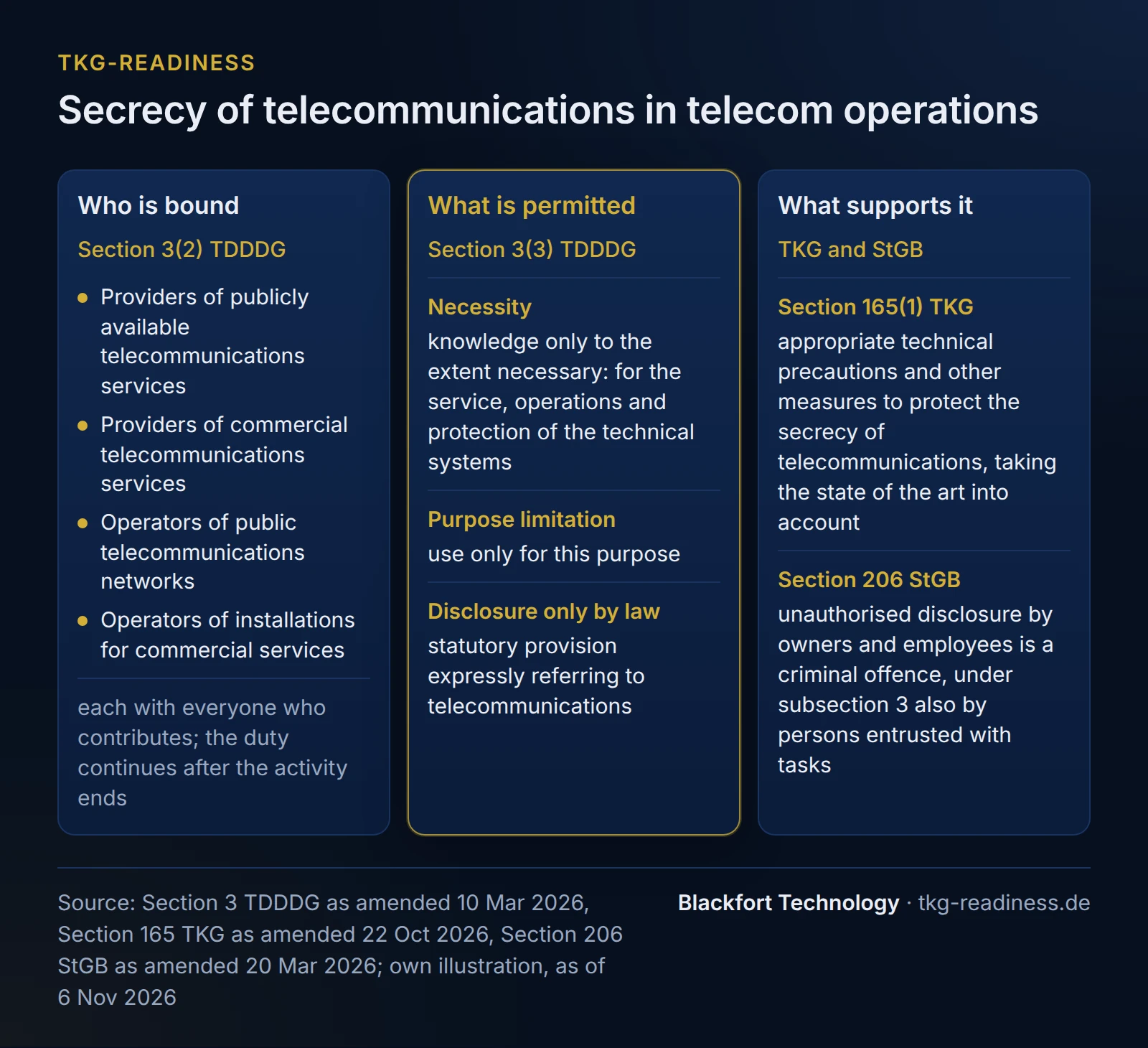
Four groups, each together with everyone who contributes to providing the services. Section 3(2) sentence 1 TDDDG lists them. The examples in the third column are our classification:
| No. | Obliged under Section 3(2) sentence 1 TDDDG | Examples (our classification) |
|---|---|---|
| 1 | Providers of publicly available telecommunications services and natural and legal persons who contribute to providing such services | Internet access providers, VoIP and cloud telephony providers; as contributors, for example, platform operators, wholesale suppliers and on-call service providers |
| 2 | Providers of telecommunications services offered wholly or partly on a commercial basis, and those who contribute | Offers that are not publicly available but are provided on a commercial basis, possibly Wi-Fi for guests or tenants |
| 3 | Operators of public telecommunications networks | Fibre network operators, the telecoms arm of a municipal utility, cable network operators |
| 4 | Operators of telecommunications installations used to provide telecommunications services on a commercial basis | Whoever operates the technical platform over which another party provides its service |
Under Section 3(2) sentence 2, the duty continues after the end of the activity that gave rise to it. Anyone who leaves therefore remains bound. Unlike the security duties under Section 165(2) and Sections 166 and 168 TKG, the secrecy of telecommunications under nos. 2 and 4 does not require a publicly available service. Whether you are a telecom provider at all is explained on the page Am I a telecom provider?.
What may technical staff and customer service know?
Only as much as is necessary for the service and operations. Section 3(3) TDDDG prohibits those obliged from obtaining, for themselves or others, knowledge of the content or the detailed circumstances beyond what is necessary for providing the telecommunications services or operating their networks or installations, “including the protection of their technical systems” (unofficial translation). Three rules follow from this:
- Necessity: knowledge only to the extent required, for the service, operations and protection of the systems.
- Purpose limitation: the knowledge may only be used for this purpose.
- Disclosure only by law: use for other purposes, in particular disclosure to others, is permitted only where the TDDDG or another statutory provision provides for it and expressly refers to telecommunications processes. The duty to report under Section 138 StGB takes precedence.
For typical situations in operations, this looks as follows in our reading. The table does not replace an assessment of the individual case:
| Situation | Classification under Section 3(3) TDDDG (our reading) | Practical rule |
|---|---|---|
| Technical staff check the signalling of a faulty line | necessary for operations | limit to the faulty line and the duration of the fault |
| Analysing connection data to fend off an attack on the platform | protection of the technical systems is expressly named | limit the scope to the attack, document purpose and persons involved |
| A caller claiming to be the police asks for connection data | disclosure only with a legal basis expressly referring to telecommunications | no information over the phone, forward to the named office, which checks the legal basis and form, even if the matter is said to be urgent |
| A third party, such as a relative or employer, asks whom a customer has called | disclosure to others without a legal basis | no information |
When a telecom provider must cooperate in interception measures and information requests is governed separately in the TKG, see cooperation under Section 170 TKG and customer data and information procedures. How long traffic data may be stored and for what it may be used is governed by further provisions of the TDDDG, which this page does not cover.
How does Section 3 TDDDG relate to Section 165(1) TKG?
Section 3 TDDDG governs conduct, Section 165(1) TKG governs protection through technology and organisation. In our classification, the two complement each other: the TDDDG prohibits listening in and passing on. Section 165(1) TKG requires everyone who provides telecommunications services or contributes to them to take appropriate technical precautions and other measures to protect the secrecy of telecommunications and against breaches of the protection of personal data, taking the state of the art into account. Section 165(1) does not require a publicly available service either.
Anyone who operates a public telecommunications network or provides publicly available telecommunications services describes these measures in the security concept. Catalogue 2.0, which is in force, deals with the secrecy of telecommunications and data protection in chapter 4, and the draft version 2025-10 in a separate area 4.1 “Protection of the secrecy of telecommunications and personal data”. The draft has not been adopted (as of 6 November 2026). The other protective measures are explained on the page protective measures under Section 165 TKG, the catalogue on the page catalogue of security requirements.
What role does Section 206 StGB play?
It makes unauthorised disclosure a criminal offence. Under Section 206(1) StGB, anyone who, as the owner or an employee of a company that provides postal or telecommunications services on a commercial basis, without authorisation discloses to another person facts that are subject to the secrecy of telecommunications and that became known to them in that capacity is liable to imprisonment of up to five years or a fine. The same penalty applies to anyone who, as owner or employee, permits or facilitates such a disclosure (subsection 2 no. 3). This summary of the wording is our own unofficial translation.
Subsection 3 extends criminal liability to persons who supervise such a company, who are entrusted by it or with its authorisation with providing telecommunications services, or who are entrusted with producing an installation for its operation or with work on it. In our reading, this also covers service providers in on-call service and maintenance. Whether a disclosure was unauthorised depends on the individual case. For operations, this means that employees and service providers should know what they may and may not do.
How do you put the secrecy of telecommunications into practice?
With clear rules that everyone involved knows and has confirmed. Section 3 TDDDG does not prescribe a particular form. We recommend five building blocks:
- Commitment of employees: Every person with access to the network, the platform, customer systems or connection data confirms in writing on joining that they have been instructed on Section 3 TDDDG and Section 206 StGB. The instruction is repeated when their role changes.
- Commitment of service providers: The contract contains a clause on protecting the secrecy of telecommunications. The service provider commits the persons it deploys and keeps a list that you can request. More on service providers in the network: supply chain in telecom networks.
- Permissions based on necessity: Who may see connection data, signalling or recordings follows from the task. Access is logged and reviewed regularly. In more depth: access to network elements.
- Rule for requests from third parties and authorities: A named office receives requests and checks the legal basis. Technical staff and customer service give no information over the phone.
- Training: Technical staff and customer service are trained annually, with examples from your own operations. Attendance is documented.
Example: commitment at a VoIP provider
Fictitious example, not a client. A VoIP provider with 30 employees runs a telephony platform for business customers in a rented data centre. It has outsourced on-call service at night and at weekends to a service provider, and six people work in customer service. It is a provider of a publicly available telecommunications service and therefore bound under Section 3(2) sentence 1 no. 1 TDDDG. Both tables are our suggestion, and all details are invented.
Confidentiality declaration (for employees, one copy per person):
| Section | Text in the example |
|---|---|
| Person | Name, function: customer service, joined on 1 December 2026 |
| Subject matter | Content and detailed circumstances of telecommunications, in particular the fact whether someone is or was involved in a telecommunications process, including unsuccessful connection attempts (Section 3(1) TDDDG) |
| Permitted scope | Knowledge only to the extent necessary for providing our services, operating the platform and protecting the technical systems; use only for this purpose (Section 3(3) TDDDG) |
| Disclosure | Only if a statute provides for it with express reference to telecommunications processes. Requests from authorities and third parties go to the security officer without any information being given |
| Duration | Also applies after the end of the employment relationship (Section 3(2) sentence 2 TDDDG) |
| Criminal law notice | Unauthorised disclosure of facts that are subject to the secrecy of telecommunications can be punished under Section 206 StGB with imprisonment of up to five years or a fine. |
| Suspected breach | Report immediately to the security officer, who checks whether a notification under Section 168 or Section 169 TKG is needed |
| Confirmation | “I have been instructed and have received a copy.” Date, signature of the person, signature for the employer |
Commitment overview (kept by the security officer):
| Group of persons | Access to | Commitment | Status in the example |
|---|---|---|---|
| Platform engineering (5 persons) | Platform, signalling, connection data | Declaration on joining, annual training | all signed, training in March |
| Customer service (6 persons) | Customer data, connection overviews at the customer's request | Declaration on joining, annual training | one declaration missing (joined on 1 December 2026) |
| On-call service (service provider) | Platform at night and at weekends | Contract clause, service provider commits its staff, list of persons deployed | clause in place, list requested |
| Data centre (service provider) | Access to the racks | Contract clause | missing in the old contract, addendum requested |
| Management (2 persons) | All systems on request | Declaration | signed |
The overview shows at a glance where a commitment is missing. It is part of the evidence for the security concept under Section 166 TKG.
Three typical gaps
| Gap | Cause | Effect | Remedy |
|---|---|---|---|
| Only employees committed, service providers not | Commitment runs through HR, contracts for on-call service, maintenance or the data centre say nothing about it | Persons with access to the platform and data do not know the rules, and evidence is missing when it matters | Contract clause, request the list of persons deployed, overview as above |
| Information given over the phone | Customer service wants to help, callers pose as an authority or a relative | Disclosure of facts subject to the secrecy of telecommunications without a legal basis | Written rule, named office for requests, case examples in training |
| Access to connection data for everyone | Roles have grown over time, logging is missing | More knowledge than necessary (Section 3(3) TDDDG), no record of who accessed what and when | Permissions by task, log access, review every six months |
How we help
We set up confidentiality declarations, contract clauses for service providers, the permissions concept and training on the secrecy of telecommunications and integrate them into your security concept. We have acted as security officers under Section 166 TKG and have drawn up and updated security concepts and agreed them with the Bundesnetzagentur (BNetzA), the German Federal Network Agency. Whether a particular processing of traffic data is permitted under data protection law is a question for your data protection officer or a lawyer admitted in Germany. What has to be notified after a personal data breach is set out on the page data breach notification under Section 169 TKG.
Frequently asked questions
Does the secrecy of telecommunications also apply to guest Wi-Fi?+
Do employees have to sign a confidentiality declaration?+
May we analyse traffic to fend off attacks?+
Does the duty end when someone leaves the company?+
Where was the secrecy of telecommunications regulated before?+
Read more
- Section 165 TKG: Protective Measures, Ten Minimum Measures
- Section 169 TKG: Notifying Data Breaches to BNetzA and BfDI
- Wi-Fi Hotspots and the TKG: Duties for Public Wi-Fi Operators
- Section 168 TKG: Reporting Security Incidents to BNetzA and BSI
- Section 166 TKG Security Concept: German Telecommunications Act
- German Telecommunications Act (TKG): Telecom Security Services
Sources
- Section 3 TDDDG: confidentiality of communications, secrecy of telecommunications (gesetze-im-internet.de, German) (retrieved 2026-11-06)
- Telecommunications Digital Services Data Protection Act (TDDDG), full text (gesetze-im-internet.de, German) (retrieved 2026-11-06)
- Section 165 TKG: technical and organisational safeguards (gesetze-im-internet.de, German) (retrieved 2026-11-06)
- Section 206 StGB: violation of postal or telecommunications secrecy (gesetze-im-internet.de, German) (retrieved 2026-11-06)
- Section 138 StGB: failure to report planned offences (gesetze-im-internet.de, German) (retrieved 2026-11-06)
- Bundesnetzagentur: catalogue of security requirements (catalogue 2.0 and draft 2025-10, German) (retrieved 2026-11-06)
This content provides general technical and organisational information and does not constitute legal advice (no legal services within the meaning of the German RDG).