
Last updated: 2026-11-06
Legal status: German Telecommunications Act (Telekommunikationsgesetz, TKG) as amended on 22 October 2026, checked on 6 November 2026. This page provides a general classification, not legal advice. Whether your offering is a public telecommunications network or a publicly available telecommunications service is a question for a lawyer admitted in Germany in the individual case, especially for the borderline cases below.
When are you a telecom provider under the TKG?
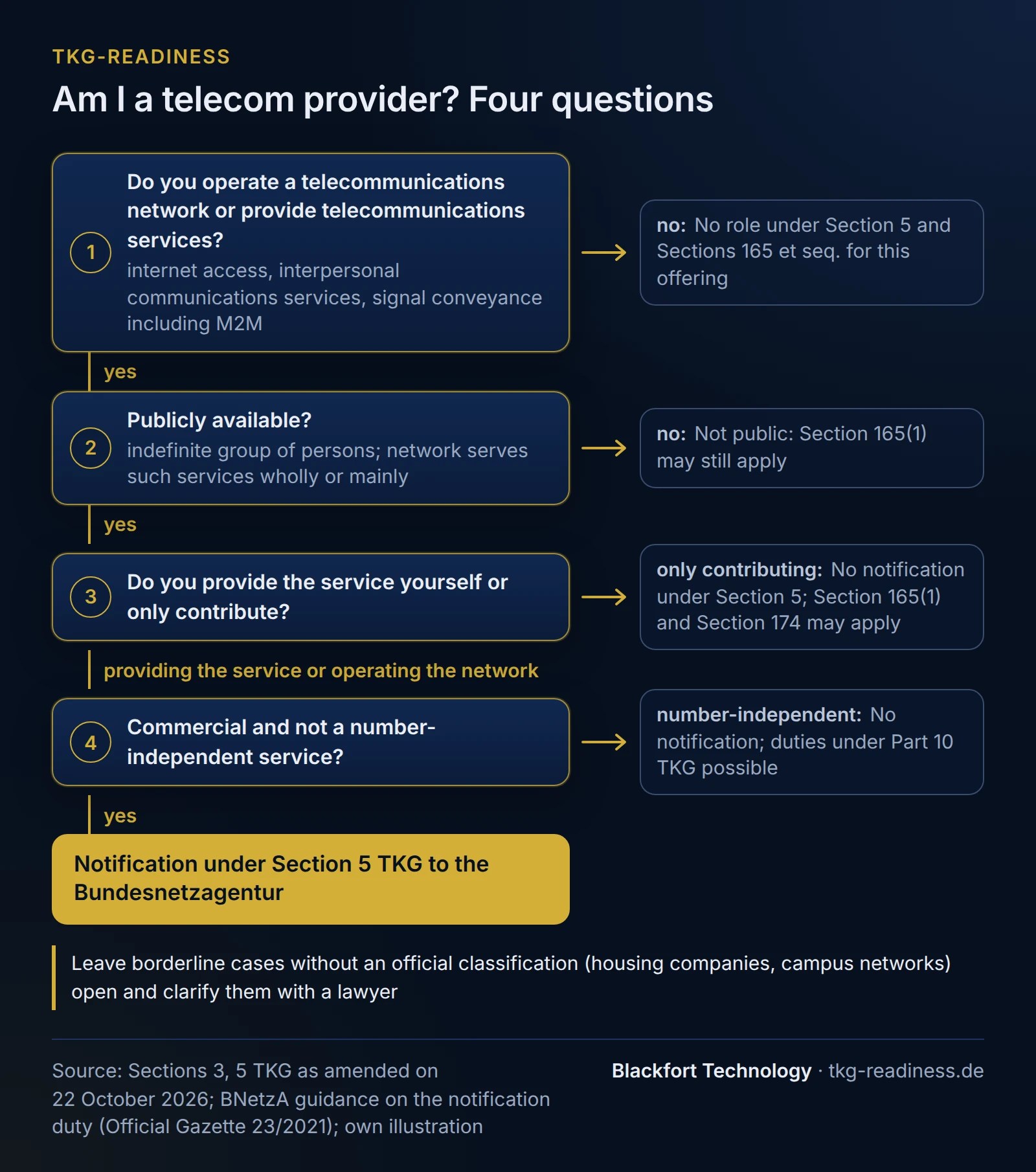
When you operate a public telecommunications network or provide publicly available telecommunications services. Both terms are defined in Section 3 TKG, and the notification under Section 5 and the security duties under Sections 165 to 168 depend on them. The following table summarises the wording and adds a check question for each term (our classification).
| Term | Provision | What the Act says | Check question |
|---|---|---|---|
| telecommunications network | Section 3 no. 65 | the entirety of transmission systems, including passive network elements | Do you own lines, ducts, radio links or systems over which signals are transmitted? |
| operator | Section 3 no. 7 | anyone who provides, or is authorised to provide, a public telecommunications network or an associated facility | Do you provide the network yourself, or does someone else provide it? |
| public telecommunications network | Section 3 no. 42 | a network used wholly or mainly to provide publicly available telecommunications services | What is the network mainly used for? |
| publicly available | Section 3 no. 44 | available to an indefinite group of persons | Can any interested party order the service, or only a clearly defined group? |
| telecommunications service | Section 3 no. 61 | services normally provided for remuneration: internet access, interpersonal communications services, signal conveyance, expressly including machine-to-machine communication | Which of your products fall into one of the three groups? |
| interpersonal communications service | Section 3 no. 24 | direct, interactive exchange between a finite number of persons; not covered where communication is only a minor ancillary feature of another service | Is communication the core of the product or only an add-on? |
| number-based / number-independent | Section 3 nos. 37, 40 | with or without a connection to numbers from national or international numbering plans | Do you assign phone numbers or enable calls to phone numbers? |
The TKG is linked to the place of the activity: it applies to everyone who operates networks or provides services in Germany (Section 1(2)). In our reading this also covers providers based abroad. What else applies to them is set out on the page for telecom providers based abroad.
Which roles does the TKG distinguish?
Three: operating a public network, providing a publicly available service, and merely contributing to the provision of a service. One company can hold several roles at once. A fibre provider with its own network and its own internet access product, for example, is both network operator and service provider.
The TKG does not define what “providing” means. The Bundesnetzagentur looks in its interpretive guidance on Section 172 at whether the service is owed to another party under a contract or for other reasons. The source does not say whether this criterion also applies to Section 5, but it is still a useful working question: who owes the service to the end customer? For the notification, the BNetzA expressly distinguishes between providing and contributing. Only a provider must notify under Section 5.
Contributing still has consequences. Section 165(1) (protection of the secrecy of telecommunications and of personal data) and the manual information procedure under Section 174(1) and (6) also apply to contributors. The following overview shows which role the Act names for the main duties. “Yes” means the wording names this role as addressee. The overview is our compilation, not an assessment of the individual case.
| Duty | public network | public service, number-based, internet access or signal conveyance | public service, number-independent | contributor only |
|---|---|---|---|---|
| Notification of the activity (Section 5) | yes, if commercial | yes, if commercial | no | no |
| Secrecy of telecommunications and data protection (Section 165(1)) | yes | yes | yes | yes |
| Protective measures, security concept, reporting security incidents (Section 165(2) to (2d), Sections 166, 168) | yes | yes | yes | no |
| Personal data breaches (Section 169) | only where also a service provider | yes | yes | no |
| Manual information procedure (Section 174(1), (6)) | where a contributor | yes | yes | yes |
What the role means for the NIS2 duties, that is classification under Section 28 of the BSI Act (BSIG) and registration with the Federal Office for Information Security (BSI), is set out on the page NIS2 for telecom providers in Germany.
Borderline cases: what is established and what remains open
For two borderline cases there are published statements by the BNetzA. For other frequently asked situations there are none. The table separates the two.
| Situation | What is established | What remains open |
|---|---|---|
| Guest Wi-Fi in a café, hotel, restaurant or shopping centre | According to the BNetzA guidance on the notification duty, the service need not be notified where guests make spontaneous, usually short-term use of it on the premises (“group B” there). Anyone who gives customers their own, permanent connection for independent use, such as an internet connection with an IP address over Wi-Fi, provides a service that must be notified (“group A”). | The guidance only concerns notification of the service. By its wording, a notification duty as network operator is unaffected, and it does not say whether the security duties under Sections 165 et seq. apply. It only refers to possible other duties. |
| M2M and IoT connectivity | Signal conveyance services for machine-to-machine communication are expressly telecommunications services (Section 3 no. 61) and, according to the guidance, must be notified if provided commercially and publicly available. The M2M service itself, such as a platform for meter data, is not a telecommunications service according to the interpretive guidance on Section 172, but the underlying transmission service is. | Who exactly provides the transmission service when several companies are involved is a question for the individual case. |
| Messaging, e-mail and other number-independent services | No notification duty (Section 5(1)). According to the BNetzA, duties under Part 10 of the TKG, including security duties, may still apply. | Which duties under Part 10 apply in detail depends on the service. |
| Networks of housing companies (in-house networks, tenant Wi-Fi) | No published BNetzA classification that we could cite. | Open. The check questions below help with preparation; the answer in the individual case comes from legal advice. |
| Campus networks (company sites, universities, industrial estates) | No published BNetzA classification that we could cite. | Open, as above. |
For the open situations, these are the questions we would prepare for legal advice. They reflect the terms in Section 3 and contain no answer:
- Is the offering open to an indefinite group of persons, or only to a fixed group, such as the employees or the tenants of a particular building?
- Does the network serve such publicly available services wholly or mainly, or mainly the company's own operations?
- Who is the end users' contracting party, who owes them the service, and who controls the network and the service technically?
- Is a charge made for use, separately or through rent or service charges?
Who must notify the activity under Section 5 TKG?
Anyone who commercially operates public telecommunications networks or commercially provides publicly available telecommunications services (Section 5(1) sentence 1). Only number-independent interpersonal communications services are exempt. The provision does not name contributors or operators of non-public networks.
According to the BNetzA, the notification gives an overview of the telecommunications market. It is not a security instrument and replaces neither the security concept under Section 166 TKG nor registration with the BSI under Section 33 BSIG.
What must be notified, when and how?
The intended start of the activity must already be notified, as must every change and the end of the activity, each without undue delay. The details:
| Item | Rule | Provision |
|---|---|---|
| Occasions | intended start, change and end of the activity; changes of name or company name, legal form and address | Section 5(1) sentence 1 |
| Deadline | without undue delay; the Act sets no lead time in days | Section 5(1) sentence 1 |
| Form | in writing or electronically, on the BNetzA form | Section 5(1) sentence 2, (2) |
| Notification form | as of 31 March 2022, separate sections for networks (with the transmission paths used) and for services (own product or resale). The responsible unit is division 215 in Mainz | BNetzA notification form |
| Confirmation | on request within one week: confirmation that the notification is complete and a certificate that the company holds the rights under the TKG | Section 5(3) |
| Register | the BNetzA publishes the notified companies with a short description, most recently as of 1 October 2026 | Section 5(4) |
| Business closed without notification | if the closure is clearly established and has not been notified within six months, the BNetzA can record the end of the activity of its own motion | Section 5(5) |
| Forwarding | the form data are sent electronically to BEREC, the Body of European Regulators for Electronic Communications | Section 5(6) |
The BNetzA points out that submarine cables are also transmission paths if they are used for public networks or services, and that existing notifications may then have to be amended. The form and contact details are on the BNetzA page on the notification duty (German).
A missing, incorrect, incomplete or late notification is an administrative offence (Section 228(2) no. 2 TKG). Classification and maximum amount are on the page fines under Section 228 TKG.
Example: role assessment with reasons
Fictitious example, not a client. A regional fibre provider with 12 employees operates its own fibre network in three municipalities and sells internet access over it to residential and business customers. Since this year it has also offered telephony with its own phone numbers via a wholesale supplier's platform and sells SIM cards from a mobile network operator to business customers for remote reading of meters and pumps. There is guest Wi-Fi in its customer centre. A housing cooperative wants to connect its own in-house network to the fibre network and pass internet access on to its tenants.
The table is our classification based on the wording of the Act and the statements by the authorities cited above. You can adopt the columns and order for your company. The “Reasons” column matters most: if the authority asks, it shows why you decided as you did.
| Check step | Answer in the example | Reasons | Evidence on file | Result |
|---|---|---|---|---|
| 1. Do we operate a telecommunications network? | yes, own fibre network with ducts and active equipment | transmission systems including passive elements (Section 3 no. 65), provided by us (Section 3 no. 7) | network plan, asset documentation | network operator |
| 2. Is the network public? | yes, it mainly serves connections for any residential and business customers | wholly or mainly publicly available services (Section 3 nos. 42, 44) | product sheet, ordering process without access restrictions | public telecommunications network |
| 3. Internet access | own product, we are the customers' contracting party | internet access service (Section 3 no. 61). We owe the service (criterion from the interpretive guidance on Section 172, our reading for Section 5) | standard customer contract | service provider, notification required |
| 4. Telephony via wholesale supplier | own product with own phone numbers, equipment at the supplier | number-based interpersonal communications service (Section 3 nos. 24, 37). We are the customers' contracting party; in our reading we provide the service and the supplier contributes | wholesale contract, customer contract, number allocation | service provider, notification required (our reading) |
| 5. SIM cards for meter reading | resale under our own contract to any business customers | signal conveyance for M2M (Section 3 no. 61), must be notified according to the guidance if commercial and publicly available. The form provides for resale | resale contract, price list | service provider, notification required |
| 6. Guest Wi-Fi in the customer centre | short-term use during the visit, no connection of one's own | “group B” of the guidance: no notification of the service. The guidance says nothing about the security duties | Wi-Fi terms of use | no service notification |
| 7. Cooperative's in-house network | network and tenant supply belong to the cooperative, we supply the connection | no published classification by the authority. The cooperative's role and ours depend on the contract and on technical control | draft contract with the cooperative | open, clarify with a lawyer before the contract is signed |
| 8. Is the existing notification up to date? | notification from 2019 covers only the network and internet access; the registered office has moved since | changes of activity and address must be notified without undue delay (Section 5(1)) | copy of the notification, extract from the BNetzA register | change notification for telephony, SIM resale and address |
| 9. What else follows from the role? | network operator and service provider | security duties under Sections 165, 166, 168 apply to both roles; the new services belong in the security concept (Section 166(1) no. 3(a)) | security concept, date of last submission | update the concept, check the submission duty |
| Approval | checked by: security officer; noted and approved by: management; date; next review with every new product, at the latest after one year | |||
Step 9 leads to the next duty: new services change the circumstances on which the security concept is based. When this requires a new submission is explained on the page security concept under Section 166 TKG.
The role assessment is available as a blank Excel template with this example under templates for download.
Three typical gaps
| Gap | Cause | Effect | Remedy |
|---|---|---|---|
| Notification never updated | the notification is seen as a one-off formality at incorporation | new services, resale or a move are missing from the register. An incorrect or incomplete notification is an offence under Section 228(2) no. 2 | add the notification as a step in product approval and in the procedure for a move or change of company name |
| Role checked only from the network side | resale, M2M connectivity or telephony via a wholesale supplier are treated as “not our network” | services are neither notified nor covered in the security concept | check every product against the three groups in Section 3 no. 61, even without equipment of your own |
| Borderline case decided without reasons | “That is not a public network” is decided verbally | if the authority asks, nobody can show who decided what and why | file the role assessment with reasons and approval, clarify open questions with a lawyer and add the result |
Role clarified: what comes next?
Once the role is clear, the security officer, security concept, protective measures and reporting routes follow from it. The order in which the duties arise for individual groups of providers is shown on the pages duties as a fibre network operator, VoIP and cloud telephony, Wi-Fi and hotspots and municipal utilities with a telecoms arm. Where you stand is shown by the status review (stage 1). We have acted as security officers under Section 166 TKG and have drawn up and updated security concepts and agreed them with the Bundesnetzagentur. The legal classification of open borderline cases belongs in the hands of a lawyer.
Frequently asked questions
Do I have to submit the notification under Section 5 TKG before launch?+
Does a messaging or e-mail service have to be notified?+
Does a hotel have to notify its guest Wi-Fi?+
What happens if I do not notify the closure of my business?+
Will I receive a confirmation of the notification?+
Read more
- NIS2 for Telecom Providers in Germany: TKG Duties, Registration
- Section 166 TKG Security Concept: German Telecommunications Act
- TKG Fines: Maximum Amounts per Offence under Section 228
- Section 168 TKG: Reporting Security Incidents to BNetzA and BSI
- German Telecommunications Act (TKG): Telecom Security Services
Sources
- Section 1 TKG: purpose and scope (gesetze-im-internet.de, German) (retrieved 2026-11-06)
- Section 3 TKG: definitions (gesetze-im-internet.de, German) (retrieved 2026-11-06)
- Section 5 TKG: notification duty (gesetze-im-internet.de, German) (retrieved 2026-11-06)
- Section 228 TKG: fines (gesetze-im-internet.de, German) (retrieved 2026-11-06)
- Bundesnetzagentur: notification duty under Section 5 TKG (German) (retrieved 2026-11-06)
- Bundesnetzagentur: guidance on the notification duty under Section 5 TKG, Official Gazette 23/2021 (PDF, German) (retrieved 2026-11-06)
- Bundesnetzagentur: notification form under Section 5 TKG, as of 31 March 2022 (PDF, German) (retrieved 2026-11-06)
- Bundesnetzagentur: interpretive guidance on Sections 172, 173 TKG, version 1.1 of 7 November 2024 (PDF, German) (retrieved 2026-11-06)
This content provides general technical and organisational information and does not constitute legal advice (no legal services within the meaning of the German RDG).