

Last updated: 2026-11-06
Legal status: German Telecommunications Act (Telekommunikationsgesetz, TKG) and BSI Act (BSI-Gesetz, BSIG), each as amended on 22 October 2026, Telecommunications Interception Ordinance (TKÜV) as amended on 22 October 2026, checked on 6 November 2026. This page provides general information, not legal advice. Which duties apply to your company in a specific case is a question for a lawyer admitted in Germany. Whether you provide the service yourself or only contribute to it, for example as a reseller, can be checked on the page am I a telecom provider?. Providers based abroad that offer telephony to customers in Germany will find what else applies to them on the page for telecom providers based abroad. Quotations from German statutes on this page are our own unofficial translations. Only the German text is legally binding.
Which TKG duties apply to service providers without their own network?
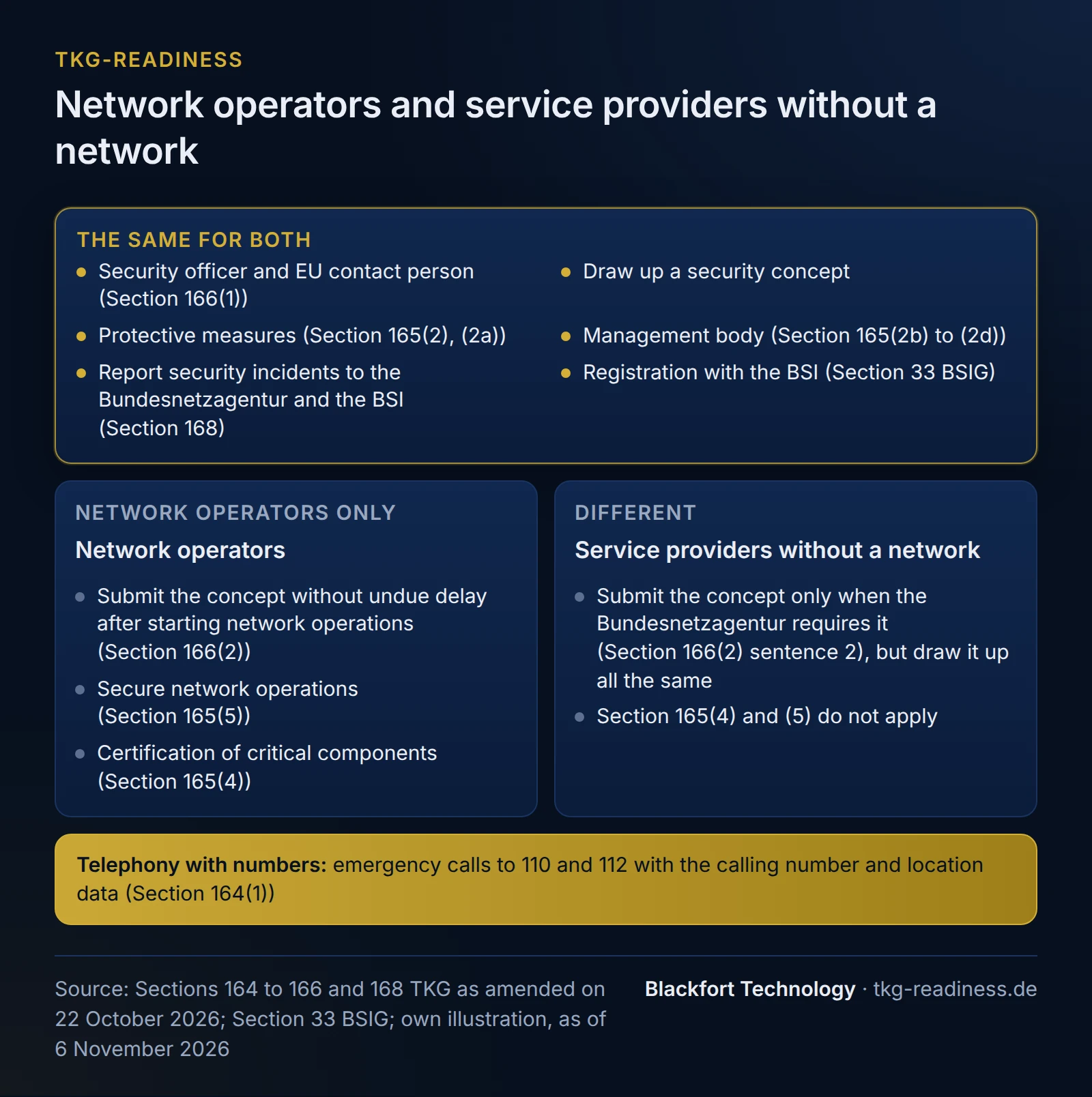
Most security duties apply unchanged, some only to network operators. The table lists them in the order in which we would tackle them.
| Duty | Provision | Applies without own network? | Note |
|---|---|---|---|
| Notify the activity to the BNetzA | Section 5 TKG | yes, if commercial, except for number-independent services | number-independent services such as messaging are exempt |
| Registration with the Federal Office for Information Security (BSI) | Section 33 BSIG | yes | at least important entity, essential entity from 50 employees or with annual turnover and balance sheet total of more than EUR 10 million each; NIS2 for telecom providers |
| Security officer, EU contact person | Section 166(1) nos. 1 and 2 TKG | yes | security officer under Section 166 TKG |
| Draw up a security concept | Section 166(1) no. 3 TKG | yes | submission only on request, see below |
| Protective measures, ten minimum measures, management body | Section 165(1) to (2d) TKG | yes | protective measures under Section 165 TKG |
| Secure network operations, certify critical components | Section 165(4) and (5) TKG | no | the wording only names operators of public networks |
| Emergency calls to 110 and 112 | Section 164 TKG | yes, for outgoing calls to telephone numbers | essentials see below |
| Report security incidents | Section 168 TKG | yes, to the BNetzA and the BSI | incident reporting under Section 168 TKG |
| Report personal data breaches | Section 169 TKG | yes | Section 169 TKG |
| Customer data and information requests | Sections 172 to 174 TKG | yes, scope depends on telephone numbers and size | customer data under Sections 172-174 TKG |
| Interception measures | Section 170 TKG, TKÜV | yes, subsection 1 or subsection 2 depending on your own equipment | see below |
The general ruling on the catalogue of security requirements under Section 167 TKG (in force: version 2.0 of 29 April 2020) is addressed to all service providers and operators. Chapter 3 applies to everyone, annex 1 additionally to providers with their own IP infrastructure. If you run your own platform, you should therefore check whether annex 1 applies to you.
Does the security concept have to be submitted to the Bundesnetzagentur?
Only if the BNetzA asks for it. Section 166(2) sentence 2 TKG provides that anyone who provides publicly available telecommunications services may be required by the Bundesnetzagentur to submit the security concept. You still have to draw it up, together with the implementation declaration stating that the measures have been implemented or will be implemented without undue delay (Section 166(1) no. 3 and (3)).
We recommend keeping the concept in a state in which it can be submitted at any time. An order to submit it is enforceable, and failing to comply is an administrative offence (Section 228(2) no. 3(c) TKG). After a submission, the duty to adapt the concept when circumstances change and to submit it again (Section 166(4) sentence 2) also applies, because it is addressed to the person “obliged under subsection 2” (in our reading). Structure and content of the concept are covered on the page security concept under Section 166 TKG.
What do emergency calls under Section 164 TKG require?
Anyone who offers publicly available number-based telephony for outgoing calls to telephone numbers must enable emergency calls to 110 and 112 free of charge (Section 164(1) sentence 1). The essentials:
- The emergency call transmits the number of the line and the data needed to determine the caller's location (subsection 1 sentence 3).
- Emergency calls take priority over other calls (subsection 1 sentence 4).
- Each provider bears its own costs for emergency calls (subsection 1 sentence 7).
- Number-independent services such as messaging only have to transmit location data if they allow a direct connection to the emergency call centre (subsection 4).
- Details are set out in the Emergency Call Ordinance (NotrufV) and a technical guideline of the BNetzA, whose requirements must be met no later than one year after publication (subsection 6).
We do not describe the content of the NotrufV and the technical guideline here. For cloud telephony a separate check is worthwhile: if customers use their number in changing places, for example when working from home or with a softphone app on the move, the registered line address does not always match the caller's location. How location data is to be determined in this case should be clarified against the NotrufV and the technical guideline. If the platform comes from an upstream provider, emergency call routing belongs in the contract. In our reading, responsibility stays with whoever provides the service to the customer.
What applies to security incidents?
The same reporting duty as for network operators, with no size threshold: significant security incidents are reported to the BNetzA and the BSI, with an early warning no later than 24 hours after becoming aware, a notification after 72 hours and a final report one month later (Section 168(1)). In cloud telephony, part of the technology often sits with third parties: the data centre, the carrier for interconnection, the platform vendor. According to the BNetzA reporting concept, whoever uses third parties remains responsible, and organisational shortcomings that delay the report count against the provider obliged to report. Service providers should therefore be contractually required to pass on incidents immediately.
Customer data and interception in outline
Providers that assign telephone numbers collect the customer data under Section 172 before activation. Under the Customer Data Information Ordinance (KDAV), databases for the automated retrieval procedure under Section 173 are needed only above 10,000 subscribers. Anyone who provides telecom services on a business basis or contributes to them answers individual requests (Section 174(6)), and below 100,000 contract partners the e-mail procedure is enough. Process and thresholds are covered on the page customer data under Sections 172-174 TKG.
For interception under Section 170 TKG, in our reading anyone who runs their own telephony platform is an operator of an installation under subsection 1, even in a rented data centre, because Section 3 no. 60 TKG also counts servers as telecommunications installations. Anyone who uses a third party's installation falls under subsection 2, and the 10,000 threshold of the TKÜV applies neither to network nodes that route voice services abroad nor to information requests on traffic data. Duties, thresholds and organisation are explained on the page Section 170 TKG and the TKÜV.
Example: duty sheet for a cloud telephony provider
Fictitious example, not a client. A provider with 18 employees sells cloud telephony to business customers across Germany. It assigns numbers from its own blocks, runs a softswitch and session border controllers in a rented data centre and interconnects with the public telephone network through a carrier. It has around 4,500 subscribers and 700 contract partners, many of them using softphones while working from home. The platform itself routes calls abroad.
The sheet is our classification based on the wording of the statute, not a review of an individual case. You can reuse the columns and rows and add "status" and "next review".
| Duty | In the example | Reason | Responsible | Evidence |
|---|---|---|---|---|
| Notification, Section 5 TKG | yes | commercial, publicly available, number-based | management | notification, entry in the BNetzA register |
| Registration, Section 33 BSIG | yes, as an important entity | provider of publicly available services, fewer than 50 employees, turnover and balance sheet total in the example below EUR 10 million | management | registration confirmation |
| Security officer, EU contact person | yes | Section 166(1) nos. 1 and 2, no size threshold | management | letter of appointment |
| Security concept | draw up, submit on request | Section 166(1) no. 3, (2) sentence 2; no own network | security officer | concept with implementation declaration, ready for submission |
| Annex 1 of catalogue 2.0 | check, in our reading yes | own IP infrastructure in the data centre | head of technology | section in the concept |
| Section 165(4) and (5) | no | not a network operator | - | note in the concept |
| Emergency calls, Section 164 | yes | outgoing calls to telephone numbers; check location separately for softphones used at home | head of technology | test record, contract with the carrier |
| Reporting, Sections 168 and 169 | yes | no size threshold; data centre and carrier in the reporting chain | security officer | reporting procedure, contract clauses |
| Customer data, Section 172 | yes | assigns telephone numbers | customer service | data fields in the customer system |
| Automated procedure, Section 173 | no | 4,500 subscribers, below the KDAV threshold | customer service | note with number of subscribers and date |
| Manual information, Section 174 | yes, e-mail procedure | below 100,000 contract partners | customer service with a specialist | process description, notice to the BNetzA |
| Interception, Section 170 | yes, as operator of an installation (our reading) | own platform; below 10,000 users, but routing abroad: the TKÜV threshold does not apply to this network node (our reading) | head of technology | clarification with BNetzA unit 218 |
| Approval | reviewed by: security officer; approved by: management; date; review again for a new product line, a new upstream provider or when a threshold is exceeded | |||
The Section 170 row shows why the detail matters: without the routing abroad, the 10,000 threshold would apply here.
Three common gaps
| Gap | Cause | Effect | Remedy |
|---|---|---|---|
| No security concept | "submission only on request" read as "no concept needed" | the duty under Section 166(1) no. 3 is not met; if an order comes, there is nothing to submit | draw up the concept, keep it ready for submission, sign the implementation declaration |
| Emergency calls tested only for the fixed location | product taken over from fixed-line logic | location data unclear for nomadic use | record usage scenarios, check them against the NotrufV and the technical guideline, document test cases |
| Third parties not in the reporting chain | data centre and carrier report faults only to their own customer service | the provider learns of the incident late and the 24-hour deadline becomes tight | add reporting duties to the contracts, maintain a contact list that works around the clock |
How we can help
We draw up and revise security concepts under Section 166 TKG for providers without their own network as well, so that they can be submitted when requested, and we set up the reporting procedure and evidence. Where you stand today is shown by the status review (stage 1). We have acted as security officers under Section 166 TKG and have drawn up and updated security concepts and agreed them with the Bundesnetzagentur.
Frequently asked questions
Do we need a security concept even though we do not operate our own network?+
We sell a platform provider's telephony under our own name. Who is responsible for emergency calls?+
Does the automated retrieval procedure under Section 173 apply to small VoIP providers?+
Does the catalogue of security requirements apply without your own network?+
Do we have to report security incidents that originate at the data centre?+
Read more
- Section 166 TKG Security Concept: German Telecommunications Act
- Section 168 TKG: Reporting Security Incidents to BNetzA and BSI
- Customer Data, Sections 172-174 TKG (German Telecommunications Act)
- Section 5 TKG: Am I a Telecom Provider? Roles, Notification
- NIS2 for Telecom Providers in Germany: TKG Duties, Registration
- German Telecommunications Act (TKG): Telecom Security Services
Sources
- Section 164 TKG: emergency calls (gesetze-im-internet.de, German) (retrieved 2026-11-06)
- Section 165 TKG: technical and organisational protective measures (gesetze-im-internet.de, German) (retrieved 2026-11-06)
- Section 166 TKG: security officer and security concept (gesetze-im-internet.de, German) (retrieved 2026-11-06)
- Section 168 TKG: reporting security incidents (gesetze-im-internet.de, German) (retrieved 2026-11-06)
- Section 170 TKG: implementing interception measures, providing information (gesetze-im-internet.de, German) (retrieved 2026-11-06)
- Emergency Call Ordinance (NotrufV) (gesetze-im-internet.de, German) (retrieved 2026-11-06)
- Telecommunications Interception Ordinance (TKÜV) (gesetze-im-internet.de, German) (retrieved 2026-11-06)
- Bundesnetzagentur: interception measures and provision of information (German) (retrieved 2026-11-06)
This content provides general technical and organisational information and does not constitute legal advice (no legal services within the meaning of the German RDG).