

Last updated: 2026-11-06
Legal status: German Telecommunications Act (Telekommunikationsgesetz, TKG) and BSI Act (BSI-Gesetz, BSIG), the act on the Federal Office for Information Security (BSI), each as amended on 22 October 2026, checked on 6 November 2026. This page sets out the statutory maximum amounts and is not legal advice. How a specific proceeding is to be assessed is a question for a lawyer admitted in Germany. We have not analysed published fining decisions of the Bundesnetzagentur, so this page says nothing about how often and in what amounts fines are actually imposed.
How is Section 228 TKG structured?
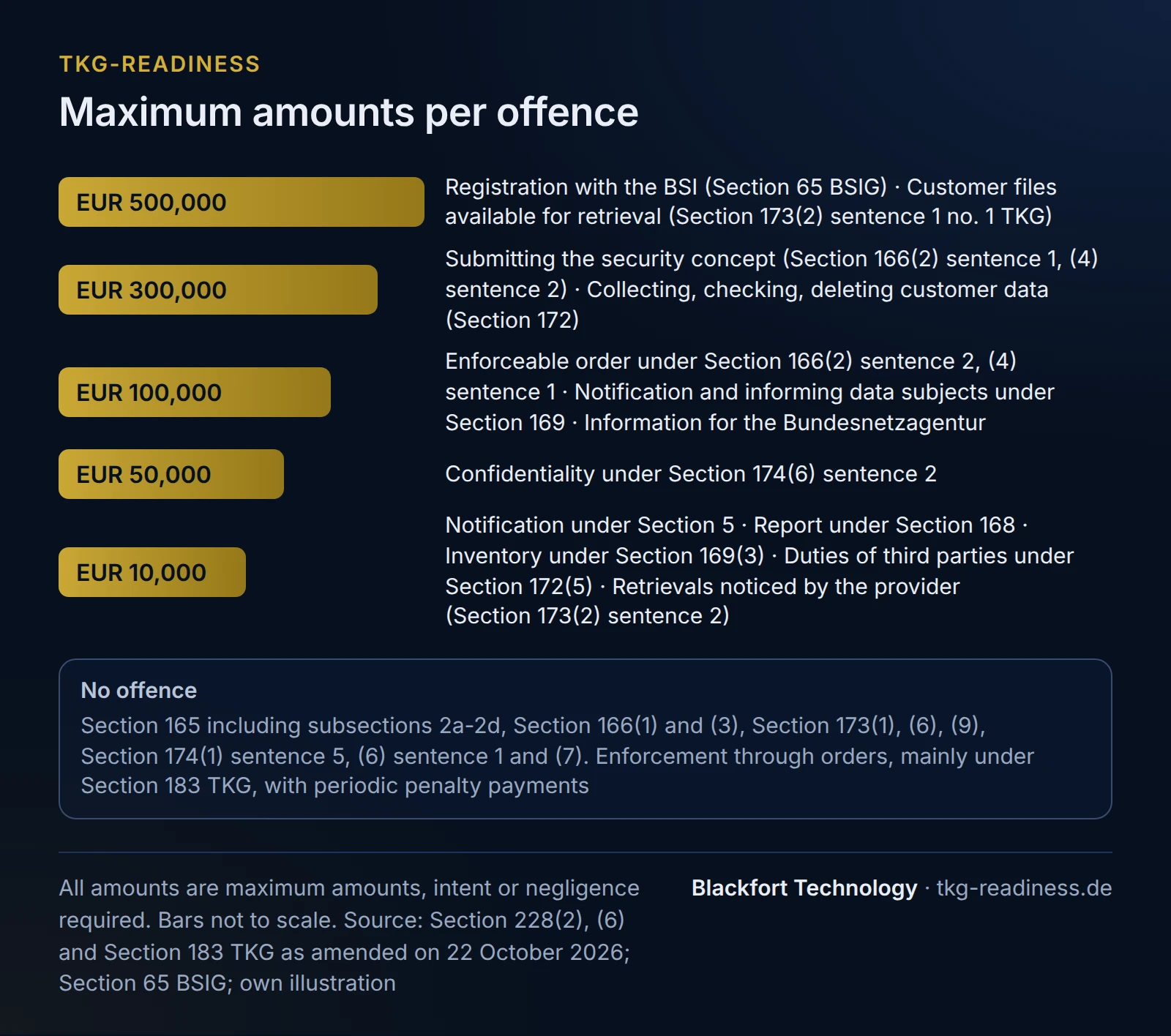
Section 228(2) TKG lists the offences one by one, and subsection 6 assigns a maximum amount to each number. Anything not expressly named in subsection 6 nos. 1 to 5 falls under the catch-all limit of EUR 10,000 (subsection 6 no. 6). The following principles apply throughout this page:
- Maximum amounts: All amounts are upper limits per offence. There is no overall limit for "breaches of the TKG".
- Intent or negligence: Every offence requires one or the other (Section 228(2)).
- Negligence: Because Section 228 does not distinguish between intent and negligence in the maximum amount, the maximum is halved for negligence under Section 17(2) of the Administrative Offences Act (OWiG) (our reading).
- Turnover-based limits: The limits of 2 % and 1 % of total turnover in Section 228(7) and (8) concern other offences, none of the duties on this page.
- Competent authority: The fining authority is the Bundesnetzagentur, which also enforces the fines (Section 228(10) and (11)).
The draft TKG Amendment Act 2026 would reword Section 228(3) to (9). The limits for the security concept (no. 38) and the report under Section 168 (no. 39) would stay the same. For other offences, for example on customer data, the draft assigns the numbers differently, in our assessment partly through a drafting error. This page therefore covers only the law in force. The draft has not been passed: after the hearing on 4 November 2026, the second and third readings have not yet taken place (as of 6 November 2026).
Table of offences: which duty, which maximum amount?
The table sums up the offences that apply to operators of public telecommunications networks and providers of publicly available telecommunications services in the areas of reporting, security and customer data. It shortens the statutory wording and leaves out offences outside these topics.
| Duty | Offence | Maximum amount | |
|---|---|---|---|
| Notify the activity (Section 5(1) TKG) | Section 228(2) no. 2 | EUR 10,000 | Notification under Section 5 TKG |
| Submit the security concept and resubmit it after changes (Section 166(2) sentence 1, (4) sentence 2 TKG) | Section 228(2) no. 38 | EUR 300,000 | Security concept under Section 166 TKG |
| Enforceable order to submit the concept or to remedy deficiencies (Section 166(2) sentence 2, (4) sentence 1 TKG) | Section 228(2) no. 3(c) | EUR 100,000 | Review by the Bundesnetzagentur |
| Report a significant security incident (Section 168(1) sentence 1 TKG) | Section 228(2) no. 39 | EUR 10,000 | Reporting under Section 168 TKG |
| Notify a personal data breach and inform data subjects (Section 169(1) sentences 1 and 2, (5) sentence 1 TKG) | Section 228(2) no. 40 | EUR 100,000 | Personal data breach under Section 169 TKG |
| Keep the inventory of personal data breaches (Section 169(3) sentence 1 TKG) | Section 228(2) no. 41 | EUR 10,000 | Personal data breach under Section 169 TKG |
| Collect, store and correct customer data (Section 172(1), (3), (4) TKG) | Section 228(2) no. 49 | EUR 300,000 | Customer data under Section 172 TKG |
| Check that the data are correct (Section 172(2) sentence 1 TKG) | Section 228(2) no. 50 | EUR 300,000 | |
| Delete the data (Section 172(6) TKG) | Section 228(2) no. 53 | EUR 300,000 | |
| Duties of third parties on customer data (Section 172(5) sentences 2 and 3 TKG) | Section 228(2) nos. 51, 52 | EUR 10,000 | - |
| Keep customer files available for automated retrieval (Section 173(2) sentence 1 no. 1 TKG) | Section 228(2) no. 54 | EUR 500,000 | - |
| Keep retrievals hidden from the provider (Section 173(2) sentence 2 TKG) | Section 228(2) no. 55 | EUR 10,000 | - |
| Keep information requests confidential (Section 174(6) sentence 2 TKG) | Section 228(2) no. 56 | EUR 50,000 | - |
| Provide information to the BNetzA (Section 183(1) sentence 2 TKG) | Section 228(2) no. 61 | EUR 100,000 | - |
| Provide information to the BNetzA (Section 203(1) sentence 1 TKG) | Section 228(2) no. 68 | EUR 100,000 | - |
| Register with the BSI (Section 33(1) BSIG) | Section 65(2) no. 6 BSIG | EUR 500,000 | NIS2 for telecom providers |
Section 228 contains no offence for the duties in the following table. They apply all the same, and the BNetzA enforces them with orders (next section).
| Duty without an offence | Enforcement |
|---|---|
| Protective measures under Section 165, including the ten minimum measures (subsection 2a) and the duties of management (subsections 2b to 2d) | Orders under Section 165(8), (9) and Section 183(1) |
| Security officer, EU contact person and drawing up the security concept (Section 166(1)), implementation declaration (Section 166(3)) | Demand to remedy deficiencies under Section 166(4), orders under Section 183(1) |
| Customer files for the automated procedure (Section 173(1), (6), (9)) | Section 183(1); for repeated breaches of Section 173(1), (6) sentence 2, (9) sentences 1 and 2, freezing the customer base (Section 183(3)) |
| Transmission in the manual information procedure (Section 174(1) sentence 5, (6) sentence 1) | Section 183(1); for repeated breaches, freezing the customer base (Section 183(3)) |
| Secured electronic interface for information requests (Section 174(7)) | Orders under Section 183(1) with periodic penalty payments, as a last resort a prohibition (Section 183(4)) |
Are there fines for the protective measures under Section 165?
No. Section 228 TKG does not mention Section 165 anywhere: neither the protective measures, nor the ten minimum measures, nor the duties of management (our analysis of the wording, not a statement by the authority). What this means for management is explained on duties of management under Section 165 TKG.
The high limits of the BSI Act of up to EUR 10 million do not apply to telecom providers for their telecommunications activity either. They are tied to Sections 30, 32, 35 and 36 BSIG, which under Section 28(5) BSIG do not apply to operators of public telecommunications networks and providers of publicly available telecommunications services. The only exception is further activities that fall under a type of entity in Annex 1 or 2 of the BSI Act. For telecom providers, the main offence left from the BSI Act is the one on registration.
How does the Bundesnetzagentur enforce the duties?
With orders, which it can enforce with periodic penalty payments if necessary. For Part 10 Chapter 1 of the TKG (Sections 164 to 183, which includes Sections 165 to 174), Section 183 TKG is the specific power, alongside the special powers in Sections 165 and 166 and the general powers in Sections 202 to 204.
| Instrument | Legal basis | What the BNetzA can do |
|---|---|---|
| Order in case of an incident or threat | Section 165(8) | order measures and implementation deadlines in case of a security incident or a significant threat |
| Order an audit | Section 165(9) sentence 1 | order an audit by a qualified independent body or a competent national authority |
| Submission and remedying deficiencies | Section 166(2) sentence 2, (4) sentence 1 | require service providers to submit the concept and demand that identified deficiencies be remedied without delay. A breach of the enforceable order is subject to a fine (no. 3(c)) |
| Orders, information, access | Section 183(1) | issue orders and take other measures, request information, enter and inspect business and operating premises during normal hours |
| Freezing the customer base | Section 183(3) | for repeated breaches of certain duties under Sections 172 to 174, order that the customer base may only change through contract expiry or termination until the duty is met |
| Prohibition | Section 183(4) | if duties are not met, prohibit the operation of the equipment or the provision of the service in whole or in part, where less intrusive measures are not enough |
| Periodic penalty payment | Section 183(5) | up to EUR 1 million to enforce measures under Section 183(1) to (4) |
| General enforcement | Section 202 | call for a statement and remedy within a deadline, then issue an order, and for serious or repeated breaches prohibit the activity. Periodic penalty payment from EUR 1,000 to EUR 10 million |
| Information and inspection | Sections 203, 204 | request information to check compliance with the duties and inspect documents. Periodic penalty payment from EUR 1,000 to EUR 10 million |
The sources do not say which legal basis the BNetzA chooses for the duties under Sections 165 to 174 in a given case. In our reading, Section 183 takes precedence as the more specific provision.
Section 174 shows the difference between a fine and enforcement: the secured interface under subsection 7 and the duty to transmit under subsection 6 sentence 1 are not subject to a fine, while confidentiality under subsection 6 sentence 2 is. For repeated breaches of subsection 6, the BNetzA can freeze the customer base. For the interface under subsection 7, orders with periodic penalty payments remain, with a prohibition as the last resort.
Fine or periodic penalty payment: what is the difference?
In our understanding, a fine sanctions a breach that has already happened, such as a late report. A periodic penalty payment is meant to enforce an order that has not yet been complied with. The TKG provides for both side by side. The periodic penalty payment is set under the Administrative Enforcement Act (Verwaltungsvollstreckungsgesetz, VwVG), which we have not analysed for this page.
Example: overview for a VoIP provider
Fictitious example, not a client. A VoIP provider without its own network has 30 employees and 8,000 subscribers. It assigns telephone numbers and sells its telephony to business customers. Its compliance officer sets up an overview that links each duty to the offence, the maximum amount and the internal evidence. The mapping is our reading of the wording.
| Duty | Applies to the provider? | Offence, maximum amount | Evidence in-house |
|---|---|---|---|
| Notification under Section 5 TKG | yes, number-based telephony | no. 2, EUR 10,000 | notification and latest change notification, extract from the register |
| Submit the security concept (Section 166(2)) | only if the BNetzA requires it (no network of its own) | breach of an enforceable order to submit: no. 3(c), EUR 100,000; once required, also resubmission after changes: no. 38, EUR 300,000 | security concept ready for submission, and a procedure for the case of a request |
| Security officer, EU contact person, drawing up the concept (Section 166(1)) | yes | no offence | appointment and designation in writing, concept with version date |
| Reporting significant security incidents (Section 168) | yes | no. 39, EUR 10,000 | reporting procedure, records of assessments |
| Personal data breaches (Section 169) | yes | no. 40, EUR 100,000; inventory no. 41, EUR 10,000 | reporting procedure, inventory of breaches |
| Collect and store customer data (Section 172) | yes, it assigns telephone numbers | nos. 49, 53, EUR 300,000 each | process at contract conclusion, deletion concept |
| Automated information procedure (Section 173) | no: under the Customer Data Information Ordinance (KDAV) only from more than 10,000 subscribers | does not apply while the threshold is not exceeded | monitor the number of subscribers each quarter |
| Confidentiality of information requests (Section 174(6) sentence 2) | yes | no. 56, EUR 50,000 | work instruction for information requests |
| Interface under Section 174(7) | yes, below 100,000 contract partners the e-mail procedure | no offence, enforcement under Section 183 | notice to the BNetzA, concept for the e-mail procedure |
| Protective measures and management (Section 165) | yes, it is at least an important entity | no offence | list of measures, report to management |
| Registration with the BSI (Section 33 BSIG) | yes | Section 65 BSIG, EUR 500,000 | confirmation of registration |
The overview helps to prioritise the evidence. It is no assessment of whether, or in what amount, the authority would impose a fine in a specific case.
Three typical gaps
| Gap | Cause | Effect | Remedy |
|---|---|---|---|
| Fine limits from the BSI Act applied to telecoms | general NIS2 information without regard to Section 28(5) BSIG | priorities follow the wrong amounts, and the duties that do carry fines, such as submission and reports, drop out of view | keep a table of offences under the TKG and Section 65 BSIG |
| "No fine, so no duty" | Section 165 is missing from Section 228 | minimum measures and management training are left undone. The BNetzA can order them and enforce them with periodic penalty payments | treat Section 165 like any other duty in the plan of measures |
| Concept not resubmitted after changes | new products or sites without a check against the security concept | offence under Section 228(2) no. 38 (Section 166(4) sentence 2) | make the check against the concept a step in every product and network change |
Documenting your duties properly
We help you set up the security concept, reporting procedures and evidence so that they are complete when the Bundesnetzagentur reviews them. We have acted as security officers under Section 166 TKG and have drawn up and updated security concepts and agreed them with the Bundesnetzagentur. Our services are summarised on telecom security under the TKG.
Frequently asked questions
Is there a fine if the ten minimum measures under Section 165(2a) TKG are missing?+
Is the fine halved for negligence?+
Who imposes fines under the TKG?+
Is there a fine if no security officer has been appointed?+
Is a late report under Section 168 TKG subject to a fine?+
Read more
- TKG Management Body: Duties under Section 165(2b) to (2d)
- Section 5 TKG: Am I a Telecom Provider? Roles, Notification
- Section 166 TKG Security Concept: German Telecommunications Act
- Section 168 TKG: Reporting Security Incidents to BNetzA and BSI
- NIS2 for Telecom Providers in Germany: TKG Duties, Registration
Sources
- Section 228 TKG: fines (gesetze-im-internet.de, German) (retrieved 2026-11-06)
- Section 183 TKG: monitoring and enforcement of obligations (gesetze-im-internet.de, German) (retrieved 2026-11-06)
- Section 202 TKG: enforcement of obligations (gesetze-im-internet.de, German) (retrieved 2026-11-06)
- Section 203 TKG: requests for information, further investigative powers, duties to transmit (gesetze-im-internet.de, German) (retrieved 2026-11-06)
- Section 204 TKG: provision of information (gesetze-im-internet.de, German) (retrieved 2026-11-06)
- Section 165 TKG: technical and organisational safeguards (gesetze-im-internet.de, German) (retrieved 2026-11-06)
- Section 166 TKG: security officer and security concept (gesetze-im-internet.de, German) (retrieved 2026-11-06)
- Section 65 BSI Act: fines (gesetze-im-internet.de, German) (retrieved 2026-11-06)
- Section 17 Administrative Offences Act: amount of the fine (gesetze-im-internet.de, German) (retrieved 2026-11-06)
- Section 1 Customer Data Information Ordinance (KDAV): scope, obligated parties (gesetze-im-internet.de, German) (retrieved 2026-11-06)
This content provides general technical and organisational information and does not constitute legal advice (no legal services within the meaning of the German RDG).