
Last updated: 2026-11-06
This page covers the review after the concept has been submitted: what the Bundesnetzagentur may review, what is known about the procedure, what happens when deficiencies are found and how to organise your evidence. How to draw up and submit the concept itself is explained on security concept under Section 166 TKG, and the protective measures in detail on protective measures under Section 165 TKG.
Legal status: German Telecommunications Act (Telekommunikationsgesetz, TKG) as amended on 22 October 2026. Catalogue of security requirements under Section 167 TKG: version 2.0 of 29 April 2020 is in force, the draft version 2025-10 has not been adopted. Checked on 6 November 2026. This page provides general information, not legal advice. How to respond legally to a letter from the Bundesnetzagentur in your case is a question for a lawyer admitted in Germany. Quotations from German statutes and from the catalogue of security requirements on this page are our own unofficial translations. Only the German text is legally binding.
What do Section 166(4) and (5) TKG provide?
Three sentences govern the review:
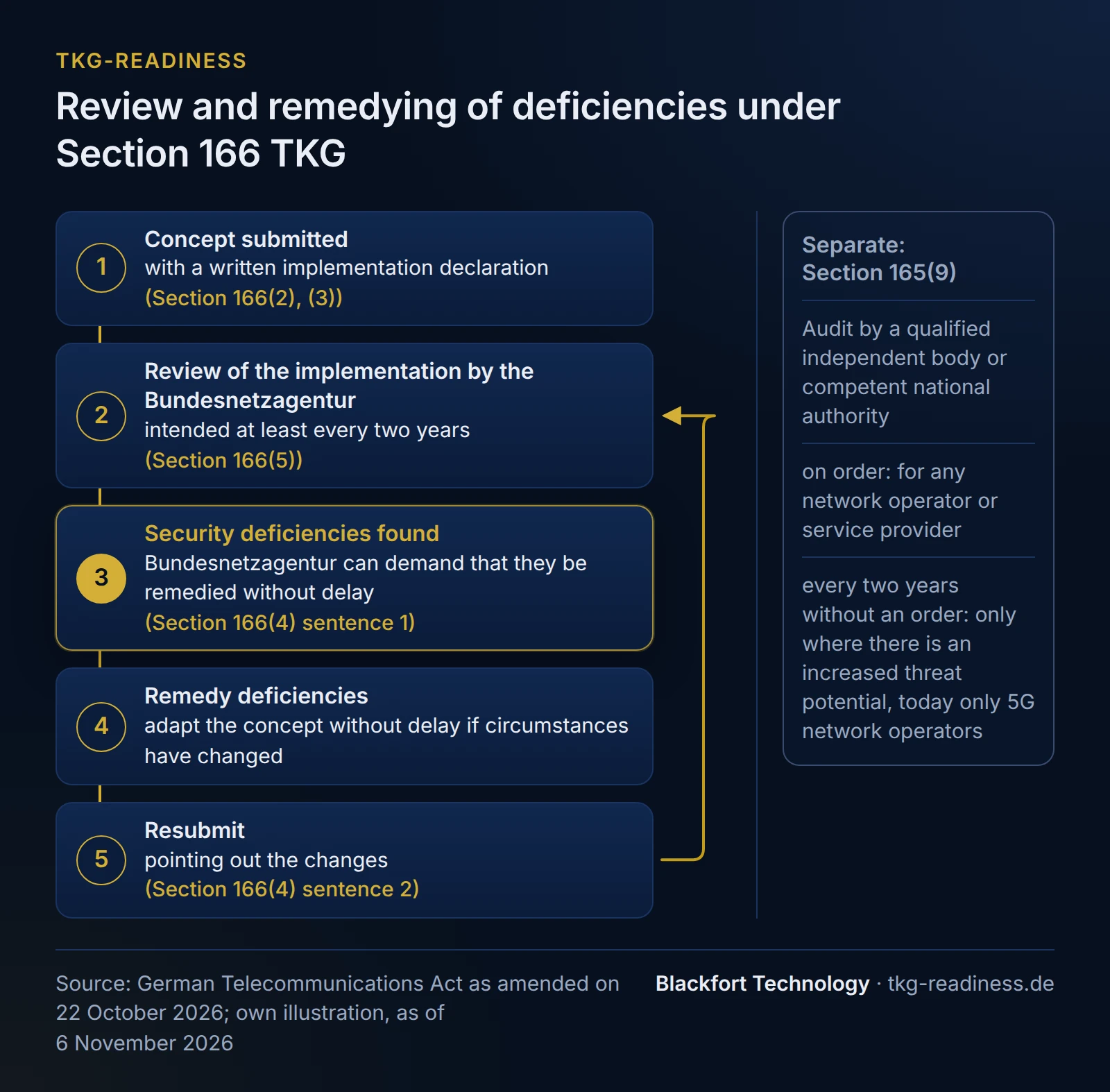
- Subsection 5: The Bundesnetzagentur regularly reviews the implementation of the security concept. The review is intended to take place at least every two years. This is a task of the authority. In our reading, it creates no separate audit duty for the company.
- Subsection 4 sentence 1: If the Bundesnetzagentur finds security deficiencies in the concept or in its implementation, it can demand that they be remedied without delay.
- Subsection 4 sentence 2: If the circumstances on which the concept is based change, the party obliged under subsection 2 adapts it without delay and resubmits it, pointing out the changes. These are network operators, and service providers from which the Bundesnetzagentur has required submission.
The yardstick for the review is the catalogue of security requirements. Under catalogue 2.0 the Bundesnetzagentur reviews the submission and, regularly, the implementation of the concept, as well as compliance with the requirements of the catalogue. The catalogue therefore describes itself as a basis "both for action and for review". What the catalogue requires chapter by chapter is explained on catalogue of security requirements under Section 167 TKG.
For the review the Bundesnetzagentur has the powers under Section 183 TKG: it can issue orders, request information and enter and inspect business and operating premises during normal business or operating hours. In addition, it has the general rights to information and inspection under Sections 203 and 204 TKG.
Two reviews that should not be confused
Besides the review under Section 166(5), the TKG provides for an audit by a qualified independent body or a competent national authority under Section 165(9). Catalogue 2.0 keeps the two expressly apart: the independent audit concerns compliance with the security duties themselves, and the security concept and its implementation are not its focus.
| Section 166(5) TKG | Section 165(9) TKG | |
|---|---|---|
| Who reviews | Bundesnetzagentur | qualified independent body or competent national authority |
| Subject | implementation of the security concept | compliance with the security duties |
| Occasion | regularly, intended at least every two years | on order for any network operator or service provider; without an order every two years only where there is an increased threat potential, today only 5G network operators. In both cases the company bears the costs (Section 165(9) sentence 5) |
| Assessment | Bundesnetzagentur | Bundesnetzagentur in agreement with the Federal Office for Information Security (BSI), also for deficiencies in the security concept |
The draft TKG Amendment Act 2026 would change Section 165(9), but not Section 166. It has not been passed. Details on the mandatory audit are on protective measures under Section 165 TKG.
How does a review work?
We have not found a current description of the procedure on the Bundesnetzagentur's pages on public safety and on the catalogue (as of 6 November 2026). Only two documents from 2017 on the legal situation at the time are on record, both from the authority's Division 217:
- According to the 2017 FAQ on data retention (there on the security concept for the retention duty of the time), the review of implementation usually took place on site, with date and scope agreed with the company in advance. Deficiencies found had to be remedied without delay on request. After that, the authority could impose a fine or set a periodic penalty payment and, as a last resort, prohibit the activity.
- According to the 2017 guidance on drawing up and submitting the security concept, a third party may draw up the concept, while responsibility stays with the company. If the third party submits it, it needs a power of attorney. A model concept submitted once and referred to by many companies is not permitted.
No current source says whether the Bundesnetzagentur still proceeds this way today. We read both documents as an indication of the practice at the time. Division 217 in Saarbrücken is responsible for the catalogue and the security concept, and it accepts confidential documents by PGP-encrypted e-mail. The Bundesnetzagentur publishes the key on its page on the catalogue.
What applies when the Bundesnetzagentur finds deficiencies?
The Bundesnetzagentur can demand that they be remedied without delay (Section 166(4) sentence 1). If it issues an enforceable order to that effect and the company acts contrary to it, this is an administrative offence with a fine of up to EUR 100,000 (Section 228(2) no. 3(c) TKG). Failing to submit an adapted concept under subsection 4 sentence 2, or submitting it incorrectly, incompletely or late, is also an administrative offence, here up to EUR 300,000 (no. 38). Failing to provide information under Section 183(1) sentence 2, or providing it incorrectly, incompletely or late, is an administrative offence up to EUR 100,000 (no. 61). All offences require intent or negligence, and for negligence the maximum amount is halved in our reading (Section 17(2) of the Administrative Offences Act, OWiG). In addition, the Bundesnetzagentur can enforce orders under Section 183 with periodic penalty payments of up to EUR 1 million. The other fines are set out on fines under the TKG.
For a list of deficiencies we recommend this approach:
- Record each deficiency separately, with its reference in the letter and in the concept.
- For each deficiency, set a measure, a responsible person and a date, and present them to management.
- If a measure takes longer than the deadline set by the authority, ask early and give documented reasons.
- Adapt the concept and the evidence file. If this changes the circumstances on which the concept is based, submit the new version pointing out the changes (subsection 4 sentence 2).
- Report the remedy in writing with evidence and file the status in the evidence file.
The evidence file: structure based on catalogue 2.0
Catalogue 2.0 requires in many places that something be documented. Sorting these places gives the structure of an evidence file with which you can prepare for a review. Tabs 1, 2 and 9 are our addition, the others follow the documentation requirements of the catalogue.
Fictitious example, not a client. The telecoms arm of a municipal utility runs an FTTH network in the town with two network nodes and offers internet access and telephony. The concept was last submitted in spring 2026. A letter from the Bundesnetzagentur announces a review of its implementation. This is what the file looks like, with all details invented:
| Tab | Content | Basis | Filed in the example | Status |
|---|---|---|---|---|
| 1 Submission | security concept as a single document, written implementation declaration, cover letter, correspondence with the Bundesnetzagentur | Section 166(2), (3) TKG; catalogue 2.0 chapters 5.1.7, 5.1.9 | concept version 4.0 (2026), declaration signed by management, acknowledgement of receipt | complete |
| 2 Roles | appointment of the security officer and deputy, designation of the EU contact person | Section 166(1) nos. 1, 2 TKG; catalogue 2.0 chapter 5.1.8 | letter of appointment, deputy arrangement | complete |
| 3 Threats | documented significant threats to networks, services and data | catalogue 2.0 chapter 3.1.1 | threat analysis 2026 | network node 2 missing |
| 4 Staff | screening method used at hiring, training records | chapters 3.2.1, 3.2.2 | attendance lists awareness training 2025 | new hires 2026 open |
| 5 Operations | defined and documented operating procedure, records of significant changes | chapters 3.4.1, 3.4.2 | operations manual, change log | complete |
| 6 Incidents | reports on the investigation and outcome of security incidents | chapter 3.5.2 | two incident reports | complete |
| 7 Emergency | emergency manual with current contact details, exercise records | chapter 3.6.1 | emergency manual, exercise record | contact list from 2023 |
| 8 Effectiveness | regular assessment, improvements made, documented deviations under grandfathering | chapters 5.1.10, 5.1.6 | annual report of the security officer | assessment 2025 missing |
| 9 Deficiencies | list of deficiencies from earlier reviews with measure, date and evidence of remedy | Section 166(4) sentence 1 TKG | no open items | complete |
In the example, the "Status" column shows three gaps to close before the appointment. In our assessment it pays to cross-reference the file to the chapters of your own concept, so that there is evidence for every measure in the concept. This structure is a working aid. The Bundesnetzagentur does not prescribe a form.
Three typical gaps before a review
| Gap | Cause | Effect | Remedy |
|---|---|---|---|
| Concept describes an old network status | network expansion or a new service was implemented, the concept was not adapted | the review finds an implementation that the concept does not reflect; where circumstances changed, resubmission under subsection 4 sentence 2 was due | link every network change to the question whether the concept is affected; adapt and submit the version |
| Measures implemented but not documented | knowledge sits with a few engineers, records are missing | the implementation cannot be shown | evidence file following the structure above, one dated document per measure |
| Implementation declaration does not match the status | the declaration confirms measures as implemented that are still planned | contradiction between the declaration and the actual status | keep the implementation status of each measure in the concept, show planned measures with a date |
We have acted as security officers under Section 166 TKG and have drawn up and updated security concepts and agreed them with the Bundesnetzagentur. The status review (stage 1) shows where your concept and evidence stand today. Our fixed-fee revision of the concept includes one round of questions from the Bundesnetzagentur, details on security concept under Section 166 TKG.
Frequently asked questions
How often does the Bundesnetzagentur review?+
Do I have to have my security concept audited every two years myself?+
May a service provider submit the documents for us?+
Is an objection already a fine?+
Is there a Bundesnetzagentur template for the evidence file?+
Read more
Sources
- Section 165 TKG: technical and organisational safeguards (gesetze-im-internet.de, German) (retrieved 2026-11-06)
- Section 166 TKG: security officer and security concept (gesetze-im-internet.de, German) (retrieved 2026-11-06)
- Section 183 TKG: orders by the Bundesnetzagentur (gesetze-im-internet.de, German) (retrieved 2026-11-06)
- Section 228 TKG: fines (gesetze-im-internet.de, German) (retrieved 2026-11-06)
- Bundesnetzagentur: catalogue of security requirements (version 2.0, general ruling, contact Division 217) (German) (retrieved 2026-11-06)
- Bundesnetzagentur: catalogue of security requirements version 2.0 of 29 April 2020 (PDF, German) (retrieved 2026-11-06)
- Bundesnetzagentur: guidance on drawing up and submitting the security concept under Sections 109(4), 113g TKG (2017, former legal situation, PDF, German) (retrieved 2026-11-06)
- Bundesnetzagentur: FAQ on data retention, Division 217, as of 18 May 2017 (former legal situation, PDF, German) (retrieved 2026-11-06)
This content provides general technical and organisational information and does not constitute legal advice (no legal services within the meaning of the German RDG).