
Last updated: 2026-11-06
Legal status: German Telecommunications Act (Telekommunikationsgesetz, TKG) as amended on 22 October 2026, catalogue of security requirements of the Bundesnetzagentur (BNetzA), the German Federal Network Agency, version 2.0 of 29 April 2020, checked on 6 November 2026. This page goes into one of the ten minimum measures in detail. The overview of all of them is on the page protective measures under Section 165 TKG. This is general information, not legal advice. Whether and how a duty applies to your company is a question for a lawyer admitted in Germany. Quotations from German statutes and from the catalogue of security requirements on this page are our own unofficial translations. Only the German text is legally binding.
What does Section 165(2a) no. 4 TKG require?
The provision requires measures for "supply chain security, including security-related aspects of the relationships between each entity and its direct suppliers or service providers". It applies to operators of public telecommunications networks and providers of publicly available telecommunications services that are essential or important entities under Section 28 of the BSI Act (BSIG). Section 28 BSIG sets no lower size threshold for these providers, so in our reading subsection 2a applies to practically every telecom provider. The classification is explained on the page NIS2 for telecom providers.
The Act does not say how the supply chain is to be secured. It names two features: the measures concern security-related aspects, and they concern the direct suppliers and service providers, meaning the companies you have a contract with yourself. Closely related is no. 5, security in the acquisition, development and maintenance of network and information systems, including vulnerability handling. When you buy and maintain a network component, both numbers apply together.
Which suppliers in a telecom network are covered?
All whose service or access can affect the security of your network or your services. Catalogue 2.0 speaks of "suppliers and agents" and requires particular care where entire business processes are outsourced, naming help desks, call centres and network connections. In the telecom network of a regional provider, in our assessment, these are mainly five groups:
| Group | Examples | Why it matters for security |
|---|---|---|
| Manufacturers of network components | OLTs, routers, switches, session border controllers, firmware | Software and updates run in the core network, often with a support access for the manufacturer |
| Maintenance and remote maintenance providers | IT service provider, on-call service, manufacturer support | administrative access to network elements, often from outside |
| Upstream providers | IP transit, wholesale telephony services, leased lines | an outage or disruption hits your services directly |
| Site and infrastructure partners | data centre, colocation, civil works, power supply at the site | physical access to equipment and cable routes |
| IT and cloud service providers | customer management, billing, ticketing, e-mail | process subscriber and traffic data, often as processors |
At shared sites, Section 165(7) also applies: each party has the duties under subsections 1 to 5 to the extent they cannot be assigned to one party. If your equipment sits in someone else's data centre, agree in writing who takes on which protective measure.
What does catalogue 2.0 in force require?
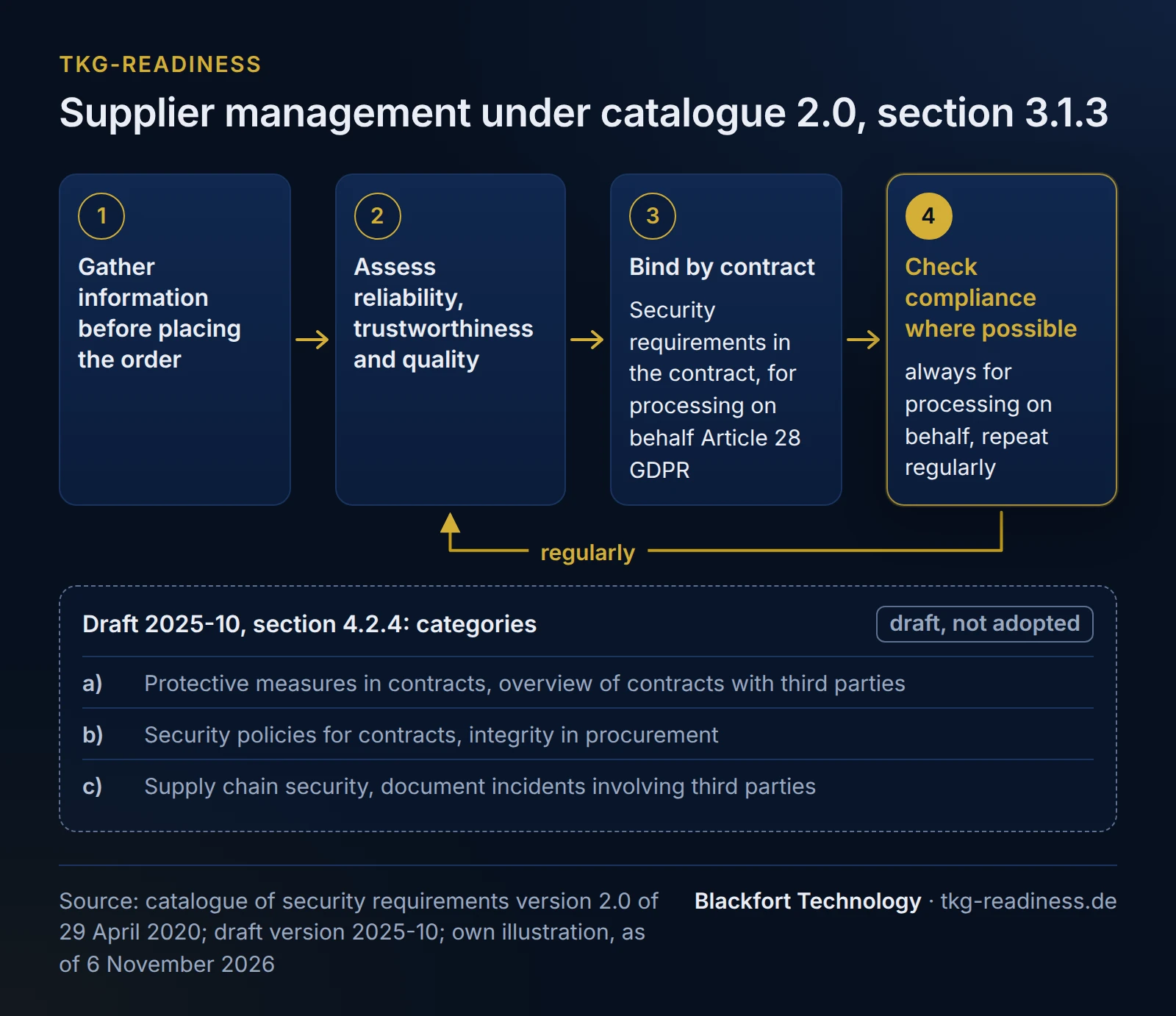
Chapter 3 of catalogue 2.0 is mandatory for all companies subject to the duty. Section 3.1.3 "Supplier management" opens with the principle: the company "must therefore assess the reliability, trustworthiness and quality of the agent or supplier", and dependencies on third parties must not impair the security of networks, services and personal data. It then sets out four points:
- Gather information before placing the order: "Information is to be gathered before the order is placed." An assessment after the contract is signed does not meet this.
- Bind by contract: "Third parties are to be bound by contract." Security requirements belong in the contractual basis, for example when buying IT products or IT services.
- Ensure data protection: for data processing on behalf of the company, Article 28 GDPR applies.
- Check compliance: the security requirements should be checked where possible, always for data processing on behalf, and the checks should be repeated regularly.
Two further parts of the catalogue concern suppliers. Chapter 3.2 expressly counts people provided by suppliers or manufacturers as personnel. And chapter 3.6.2 on recovery provides that supplier contracts are checked in advance for replacement provision. For remote maintenance providers, this page therefore covers assessing them and binding them by contract. How the remote maintenance access is secured technically is on the page access to network elements and MFA.
What would draft 2025-10 change?
The draft of the new catalogue (version 2025-10) has not been adopted (as of 6 November 2026), and catalogue 2.0 continues to apply. In the draft, section 4.2.4 is called "Security in dependencies on third parties" and gives upstream providers, cloud providers and colocation as examples. The company's security objectives and security standards would also be binding on third parties and would have to be secured by contract. The measures are graded in three levels:
| Category in the draft | Protective measures (abridged) |
|---|---|
| a) | Include protective measures in contracts with third parties, including confidentiality and secure transmission; review security policies for third parties when there is cause; an overview of contracts with third parties must exist |
| b) | Set security policies for contracts, ensure integrity in all procurement, ensure compliance by third parties, require security standards in third parties' processes, mitigate residual risks, contract management |
| c) | Ensure supply chain security, including relationships with direct suppliers, track and document incidents involving third parties, review policies for third parties regularly |
Which category a company would have to meet under the draft depends on the threat potential the draft introduces. That classification does not apply today. What the draft changes overall and how the classification is meant to work is explained on the page catalogue of security requirements under Section 167 TKG. In our assessment this means in practice: an overview of all contracts with third parties, and security clauses in those contracts, already make sense under catalogue 2.0 and would also be the lowest category, a), under the draft.
Network operators with increased threat potential, which today only 5G mobile network operators have, must in addition have critical components certified under Section 165(4) and obtain a declaration from the source of supply on its trustworthiness. The page critical components in telecommunications covers this.
How do you assess a supplier of network components?
The catalogue names three yardsticks, reliability, trustworthiness and quality, but no method. We work with a simple assessment per supplier that a small company can keep up to date. The questions are our professional recommendation, neither exhaustive nor mandatory:
- Access: Does the supplier have physical access, logical access or remote access to the network or data? This determines how critical the supplier is.
- Replaceability: Is there a second supplier or spare equipment, and how long would a switch take?
- Security practice: Does the manufacturer provide security updates for the version in use, and for how long? Is there a channel for reporting vulnerabilities? How does the service provider secure its own access?
- Contract: Does the contract contain security requirements, duties to report incidents, confidentiality and, where needed, a data processing agreement?
- Review: When was it last checked whether the supplier meets the requirements, and with what result?
Example: supplier assessment for network components
Fictitious example, not a client. A regional fibre ISP with 12 employees runs an FTTH network and offers internet access and telephony. The OLTs come from one manufacturer, an IT service provider handles maintenance by remote access, and a second service provider covers the night-time on-call service. The core network and customer systems sit in a rented data centre. This is what its supplier assessment could look like, with all details invented:
| Supplier | Service and access | Criticality | Checked before the order | Contractual security requirements | Last review | Rating, open points |
|---|---|---|---|---|---|---|
| Manufacturer A (OLT, firmware) | Hardware and software in the access network, support access on request | high | update commitment and end of support for the product line requested | vulnerability reporting channel, updates under the support contract | 03/2026 | green; security updates for the product line in use end in 2029, plan replacement |
| IT service provider B (maintenance) | Remote maintenance on OLTs and routers | high | references and own security measures requested | security annex: VPN with MFA, named technicians, incident report within 24 hours | 05/2026 | amber; technician list not reconciled for a year |
| Service provider C (on-call) | Fault intake at night, read access to network monitoring | medium | no, contract from 2019 | confidentiality, no security requirements | never | red; renegotiate a security annex, review access |
| Data centre D (colocation) | Space, power, cooling, physical access | high | site visit, operator's certificate inspected | access rules, emergency power, allocation under Section 165(7) | 01/2026 | green |
| Upstream provider E (IP transit) | Internet connectivity, no access to own systems | high (availability) | availability commitment checked | fault reporting, repair times | - | amber; only one transit, replacement provision not arranged |
| Civil works F | Work on cable routes and street cabinets | medium | no | none | never | red; arrange key handover and escort at cabinet sites |
The traffic lights are our working aid: green means assessed, bound by contract and reviewed; amber means one point is missing; red means no assessment or no security requirements. The table is also the overview of contracts with third parties that the draft would require at category a), and it belongs as evidence in the measures part of the security concept under Section 166 TKG.
Three typical gaps
| Gap | Cause | Effect | Remedy |
|---|---|---|---|
| Assessment only after the contract is signed | Purchasing runs through the technical team, security is not asked about in advance | catalogue 2.0 requires the information before the order is placed, and security clauses are hard to enforce afterwards | a short questionnaire before every order involving network or data access, with the result in the supplier assessment |
| Old contracts without security requirements | On-call service, civil works or maintenance have run on old contracts for years | precisely the service providers with access to the network or sites are not bound by contract | renegotiate a security annex at every renewal, in order of criticality |
| A single supplier without a fallback | one manufacturer or upstream provider for a central function, no spare equipment, no second route | an outage or supply stop hits operations directly, and chapter 3.6.2 provides for checked replacement provision | check replacement provision in the contract, keep spares for central components, take it into account in business continuity |
If you want to know where your company stands on the ten minimum measures as a whole, start with the status review (stage 1). We have acted as security officers under Section 166 TKG and have drawn up and updated security concepts and agreed them with the Bundesnetzagentur.
Frequently asked questions
Does Section 165(2a) no. 4 also cover my suppliers' suppliers?+
Is a supplier's certificate enough as an assessment?+
Do I have to audit every supplier on site?+
What about the manufacturer's support access?+
Does the supply chain duty also apply to VoIP providers without their own network?+
Read more
Sources
- Section 165 TKG: technical and organisational safeguards (gesetze-im-internet.de, German) (retrieved 2026-11-06)
- Section 28 BSI Act: essential and important entities (gesetze-im-internet.de, German) (retrieved 2026-11-06)
- Bundesnetzagentur: catalogue of security requirements version 2.0 of 29 April 2020 (PDF, German) (retrieved 2026-11-06)
- Bundesnetzagentur: consultation on the revised catalogue of security requirements (German) (retrieved 2026-11-06)
- Bundesnetzagentur: draft catalogue of security requirements, version 2025-10 (PDF, German) (retrieved 2026-11-06)
This content provides general technical and organisational information and does not constitute legal advice (no legal services within the meaning of the German RDG).